
Which statement is INCORRECT for mutual inductance?
The change in the strength of the current in the coil is opposed by the coil itself by inducing an EMF.
Understanding Mutual Inductance vs. Self-Inductance
The question asks us to identify the statement that is incorrect concerning mutual inductance. Mutual inductance describes the phenomenon where a change in current in one coil induces an electromotive force (EMF) in a nearby second coil due to the changing magnetic flux linking them. It's important to distinguish this from self-inductance, where a change in current in a coil induces an EMF in the *same* coil. Let's analyze each statement:
Analyzing the Statements about Inductance
Statement 1: Incorrect for Mutual Inductance
The statement says: "The change in the strength of the current in the coil is opposed by the coil itself by inducing an EMF."
This statement accurately describes self-induction. In self-induction, a coil resists changes in its own current. When the current increases, the induced EMF opposes the increase; when the current decreases, the induced EMF opposes the decrease. This effect is inherent to a single coil. Since the question is about mutual inductance, which involves interaction between two coils, this statement, while true for self-induction, is presented as an option for mutual inductance, making it potentially the incorrect one in this context.
Statement 2: Correct Description
The statement says: "The induced current developed in the neighbouring coil opposes the decay of the current in the coil when the main current in the coil decreases."
This statement aligns with Lenz's Law and the principles of mutual inductance. When the current in the primary coil decreases, the magnetic flux through the secondary coil also decreases. This change in flux induces an EMF and current in the secondary coil. According to Lenz's Law, this induced current flows in a direction that opposes the change causing it. To oppose the decay (decrease) of the primary current, the induced magnetic field in the secondary coil will try to reinforce the decreasing flux, effectively trying to maintain the original current. Thus, this statement correctly describes the behavior in mutual inductance.
Statement 3: Correct Description
The statement says: "In mutual inductance, out of the two coils, one coil opposes the change in the strength of the current flowing in the other coil."
This is the fundamental definition of mutual inductance. A changing current in one coil induces an EMF in the other, and this induced EMF opposes the change in current in the first coil, as per Lenz's Law. This statement accurately reflects the essence of mutual inductance.
Statement 4: Correct Description
The statement says: "The induced current developed in the neighbouring coil opposes the growth of current in the coil when the main current in the coil increases."
Similar to statement 2, this also follows Lenz's Law. When the current in the primary coil increases, the magnetic flux linking the secondary coil increases. The induced EMF and current in the secondary coil oppose this increase. The induced magnetic field will oppose the increasing flux, effectively trying to counteract the growth of the primary current. This is a correct description of the effect in mutual inductance.
Conclusion
Statement 1 describes self-induction, where a coil opposes changes in its *own* current. Statements 2, 3, and 4 correctly describe phenomena related to mutual inductance, involving the interaction between two coils. Therefore, the statement that is incorrect specifically in the context of mutual inductance is the one describing self-induction.
Important Questions from Mutual Inductance
Two inductors whose self-inductance is 80 mH and 60 mH are connected in parallel aiding. The equivalent inductance of the combination is 48.75 mH. Calculate their mutual inductance.
Two inductors L1 = 20 mH and L2 = 40 mH are connected in series so that their equivalent inductance is 50 mH. The mutual inductance between the two coils is _______.
Which of the following devices does not work on the principle of mutual induction?
Calculate the total inductance (in H) of the circuit shown below:
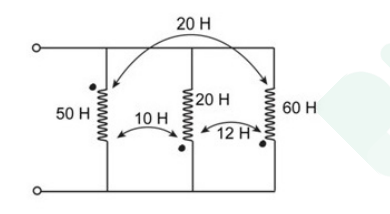
A transformer has 350 primary turns and 1050 secondary turns. The primary winding is connected across a 230 V, 50 Hz supply. The induced EMF in the secondary will be


