
Two inductors L1 = 20 mH and L2 = 40 mH are connected in series so that their equivalent inductance is 50 mH. The mutual inductance between the two coils is _______.
5 mH
Inductors in Series: Understanding Equivalent Inductance and Mutual Inductance
When two inductors, say \(L_1\) and \(L_2\), are connected in series, their combined or equivalent inductance (\(L_{eq}\)) depends on whether their magnetic fields aid or oppose each other. This interaction is described by a property called mutual inductance (\(M\)).
Inductance Formulas for Series Connection
For two inductors connected in series, the equivalent inductance is calculated using one of two formulas, depending on the coupling:
- Series Aiding Connection: In this configuration, the magnetic fields produced by the two inductors add up, increasing the total inductance. The formula is: \[L_{eq} = L_1 + L_2 + 2M\] Here, \(L_1\) and \(L_2\) are the self-inductances of the individual coils, and \(M\) is the mutual inductance between them.
- Series Opposing Connection: In this configuration, the magnetic fields produced by the two inductors partially cancel each other out, decreasing the total inductance. The formula is: \[L_{eq} = L_1 + L_2 - 2M\] Again, \(L_1\) and \(L_2\) are self-inductances, and \(M\) is the mutual inductance.
Calculating Mutual Inductance Step-by-Step
Let's apply these concepts to the given problem. We are provided with the following information:
- Self-inductance of the first inductor, \(L_1 = 20 \text{ mH}\)
- Self-inductance of the second inductor, \(L_2 = 40 \text{ mH}\)
- Equivalent inductance of the series connection, \(L_{eq} = 50 \text{ mH}\)
We need to find the mutual inductance (\(M\)) between the two coils.
First, let's consider the scenario where the inductors are connected in series aiding. If they were series aiding, the equivalent inductance would be:
\[L_{eq} = L_1 + L_2 + 2M\] \[50 \text{ mH} = 20 \text{ mH} + 40 \text{ mH} + 2M\] \[50 = 60 + 2M\] \[2M = 50 - 60\] \[2M = -10 \text{ mH}\] Since mutual inductance (\(M\)) cannot be negative (as it represents a physical interaction that transfers energy), this indicates that the inductors are not connected in series aiding.
Therefore, the inductors must be connected in series opposing. Using the formula for series opposing connection:
\[L_{eq} = L_1 + L_2 - 2M\]
Now, substitute the given values into this equation:
\[50 \text{ mH} = 20 \text{ mH} + 40 \text{ mH} - 2M\]
Combine the self-inductances:
\[50 = 60 - 2M\]
To find \(2M\), rearrange the equation:
\[2M = 60 - 50\] \[2M = 10 \text{ mH}\]
Finally, calculate \(M\) by dividing by 2:
\[M = \frac{10 \text{ mH}}{2}\] \[M = 5 \text{ mH}\]
Summary of Inductor Calculation
The mutual inductance between the two coils is \(5 \text{ mH}\). This calculation confirms that for the equivalent inductance to be less than the sum of individual inductances (\(20 \text{ mH} + 40 \text{ mH} = 60 \text{ mH}\)), the inductors must be connected in a series opposing manner.
| Component | Value |
|---|---|
| Inductor 1 (\(L_1\)) | 20 mH |
| Inductor 2 (\(L_2\)) | 40 mH |
| Equivalent Inductance (\(L_{eq}\)) | 50 mH |
| Calculated Mutual Inductance (\(M\)) | 5 mH |
Important Questions from Mutual Inductance
Two inductors whose self-inductance is 80 mH and 60 mH are connected in parallel aiding. The equivalent inductance of the combination is 48.75 mH. Calculate their mutual inductance.
Which of the following devices does not work on the principle of mutual induction?
Which statement is INCORRECT for mutual inductance?
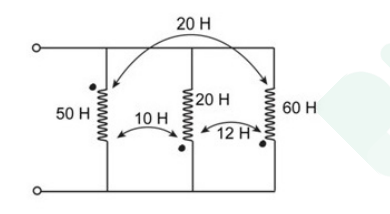
Calculate the total inductance (in H) of the circuit shown below:
A transformer has 350 primary turns and 1050 secondary turns. The primary winding is connected across a 230 V, 50 Hz supply. The induced EMF in the secondary will be


