
Which of the following devices does not work on the principle of mutual induction?
Tesla Coil
Mutual Induction Principle Explained
Mutual induction is a key concept in electromagnetism. It describes the phenomenon where a changing electric current in one circuit (or coil) induces a voltage, also known as an electromotive force (EMF), in a second circuit (or coil) situated nearby. This happens because the changing current generates a changing magnetic field, and this fluctuating magnetic field passes through the second coil, inducing an EMF according to Faraday's Law of Induction. The strength of this effect is quantified by the mutual inductance, denoted by '$M$'. The relationship is expressed mathematically as: $E = -M \frac{dI}{dt}$ Where '$E$' is the induced EMF, '$M$' is the mutual inductance, and '$\frac{dI}{dt}$' is the rate of change of current in the first coil.
Analyzing Devices Based on Mutual Induction
We can understand the operation of each device to see how it relates to mutual induction:
Transformer Operation Using Mutual Induction
A transformer is a device engineered specifically to utilize mutual induction. It typically consists of two coils, the primary and the secondary, wound around a common magnetic core (often iron). When an alternating voltage is applied to the primary coil, it drives an alternating current, creating a continuously changing magnetic flux within the core. This changing magnetic flux links strongly with the secondary coil, inducing an alternating voltage across it. The ratio of the induced voltage in the secondary coil ($V_s$) to the voltage in the primary coil ($V_p$) is approximately equal to the ratio of the number of turns in the secondary coil ($N_s$) to the number of turns in the primary coil ($N_p$): $ \frac{V_s}{V_p} \approx \frac{N_s}{N_p} $ This makes transformers essential for stepping voltages up or down in power distribution systems.
Induction Coil Function and Mutual Induction
An induction coil is another device that heavily relies on mutual induction. Its primary function is to generate high-voltage electrical pulses from a low-voltage direct current (DC) source. It achieves this using a rapidly switching mechanism (an interrupter) that repeatedly breaks and makes the current flow in the primary coil. Each time the current is interrupted, the magnetic field generated by the primary coil collapses extremely rapidly. This rapid change in magnetic flux induces a significantly high voltage in the secondary coil due to the strong effect of mutual induction.
Motor Principle: Force, Not Primarily Mutual Induction
An electric motor operates on a different fundamental principle: the motor effect. This principle states that a conductor carrying an electric current within a magnetic field experiences a force. This force, often described by the Lorentz force equation ($ \vec{F} = q(\vec{E} + \vec{v} \times \vec{B}) $ or for a wire segment $ \vec{F} = I(\vec{L} \times \vec{B}) $), results in a torque that causes the motor's rotor to rotate. Converting electrical energy into mechanical energy is the core function. Although certain types of motors, such as induction motors, do involve induced currents in the rotor caused by the relative motion between the rotor and the stator's magnetic field (which relates to electromagnetic induction), the primary mechanism driving the rotation is the magnetic force on currents, rather than mutual induction between two distinct coils acting primarily as an energy transfer mechanism like in a transformer.
Tesla Coil: Mutual Induction and Resonance
A Tesla coil, invented by Nikola Tesla, is a type of resonant transformer circuit. It is famous for generating high-voltage, high-frequency alternating current. A typical Tesla coil setup includes a primary coil, a secondary coil, a capacitor, and often a spark gap. Mutual induction is indeed involved, facilitating the transfer of energy between the primary and secondary coils. However, the Tesla coil's operation is critically dependent on resonance. Both the primary and secondary circuits are designed to oscillate at similar resonant frequencies. This resonance dramatically amplifies the energy transfer and voltage output, leading to the extremely high voltages characteristic of Tesla coils. Therefore, while mutual induction is a component, resonance is the defining feature of its operation.
Device Not Primarily Based on Mutual Induction
Considering the principles of operation: Transformers and induction coils are fundamentally based on mutual induction for their core function. Electric motors operate primarily based on the force experienced by current-carrying conductors in magnetic fields (Lorentz force). Tesla coils utilize mutual induction but are distinctively characterized by their operation involving resonant electrical circuits. Among the given options, the Tesla Coil is identified as the device whose operation involves principles beyond just mutual induction, setting it apart from devices like transformers and induction coils.
Important Questions from Mutual Inductance
Two inductors whose self-inductance is 80 mH and 60 mH are connected in parallel aiding. The equivalent inductance of the combination is 48.75 mH. Calculate their mutual inductance.
Two inductors L1 = 20 mH and L2 = 40 mH are connected in series so that their equivalent inductance is 50 mH. The mutual inductance between the two coils is _______.
Which statement is INCORRECT for mutual inductance?
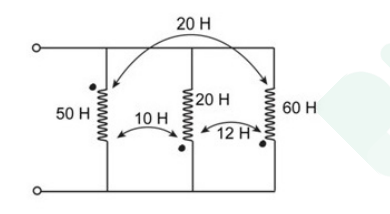
Calculate the total inductance (in H) of the circuit shown below:
A transformer has 350 primary turns and 1050 secondary turns. The primary winding is connected across a 230 V, 50 Hz supply. The induced EMF in the secondary will be


