
Two inductors whose self-inductance is 80 mH and 60 mH are connected in parallel aiding. The equivalent inductance of the combination is 48.75 mH. Calculate their mutual inductance.
30 mH
Inductors in Parallel Aiding: Calculating Mutual Inductance
When two inductors are connected in parallel, their individual self-inductances, along with any mutual inductance between them, determine the total equivalent inductance of the combination. The concept of mutual inductance arises when the magnetic field produced by one inductor links with the other inductor, inducing a voltage in it. In a "parallel aiding" connection, the magnetic fields produced by the currents in both inductors add up, increasing the total flux linkage.
Understanding Inductance and Mutual Inductance
- Self-Inductance (\(L\)): This is a property of an inductor that opposes changes in the current flowing through it. It is measured in Henries (H).
- Mutual Inductance (\(M\)): This occurs when the magnetic flux of one inductor links with another inductor, inducing a voltage in the second inductor when the current in the first one changes. It is also measured in Henries (H).
- Parallel Aiding Connection: In this configuration, the inductors are connected in parallel, and their magnetic fields are arranged such that they reinforce each other, meaning the mutual flux adds to the self-fluxes.
Formula for Parallel Aiding Inductors
For two inductors \(L_1\) and \(L_2\) connected in parallel aiding, with a mutual inductance \(M\), the equivalent inductance (\(L_{eq}\)) is given by the formula:
\[ L_{eq} = \frac{L_1 L_2 - M^2}{L_1 + L_2 - 2M} \]We are given the values for \(L_1\), \(L_2\), and \(L_{eq}\), and we need to find \(M\).
Given Data
- First self-inductance, \(L_1 = 80 \, \text{mH}\)
- Second self-inductance, \(L_2 = 60 \, \text{mH}\)
- Equivalent inductance of the parallel aiding combination, \(L_{eq} = 48.75 \, \text{mH}\)
Mutual Inductance Calculation
Let's substitute the given values into the formula and solve for \(M\):
\[ 48.75 = \frac{(80)(60) - M^2}{80 + 60 - 2M} \]First, simplify the numerator and denominator:
\[ 48.75 = \frac{4800 - M^2}{140 - 2M} \]Now, multiply both sides by \((140 - 2M)\):
\[ 48.75 (140 - 2M) = 4800 - M^2 \]Distribute \(48.75\) on the left side:
\[ (48.75 \times 140) - (48.75 \times 2M) = 4800 - M^2 \] \[ 6825 - 97.5M = 4800 - M^2 \]Rearrange the terms to form a standard quadratic equation (\(aM^2 + bM + c = 0\)):
\[ M^2 - 97.5M + 6825 - 4800 = 0 \] \[ M^2 - 97.5M + 2025 = 0 \]We can solve this quadratic equation using the quadratic formula, \(M = \frac{-b \pm \sqrt{b^2 - 4ac}}{2a}\), where \(a=1\), \(b=-97.5\), and \(c=2025\).
\[ M = \frac{-(-97.5) \pm \sqrt{(-97.5)^2 - 4(1)(2025)}}{2(1)} \] \[ M = \frac{97.5 \pm \sqrt{9506.25 - 8100}}{2} \] \[ M = \frac{97.5 \pm \sqrt{1406.25}}{2} \]Calculate the square root of \(1406.25\):
\[ \sqrt{1406.25} = 37.5 \]Now, substitute this value back into the quadratic formula to find the two possible values for \(M\):
Case 1: Using the positive root
\[ M_1 = \frac{97.5 + 37.5}{2} = \frac{135}{2} = 67.5 \, \text{mH} \]Case 2: Using the negative root
\[ M_2 = \frac{97.5 - 37.5}{2} = \frac{60}{2} = 30 \, \text{mH} \]Both \(67.5 \, \text{mH}\) and \(30 \, \text{mH}\) are mathematically valid solutions for the quadratic equation. In physics, mutual inductance \(M\) must be less than or equal to \(\sqrt{L_1 L_2}\) (i.e., the coefficient of coupling \(k \le 1\)). For \(L_1=80 \, \text{mH}\) and \(L_2=60 \, \text{mH}\), \(\sqrt{L_1 L_2} = \sqrt{80 \times 60} = \sqrt{4800} \approx 69.28 \, \text{mH}\). Both calculated values for \(M\) are less than \(69.28 \, \text{mH}\), making both physically possible.
Given the options, the value \(30 \, \text{mH}\) is present as an option.
Conclusion
The mutual inductance between the two inductors connected in parallel aiding is found to be \(30 \, \text{mH}\).
Important Questions from Mutual Inductance
Two inductors L1 = 20 mH and L2 = 40 mH are connected in series so that their equivalent inductance is 50 mH. The mutual inductance between the two coils is _______.
Which of the following devices does not work on the principle of mutual induction?
Which statement is INCORRECT for mutual inductance?
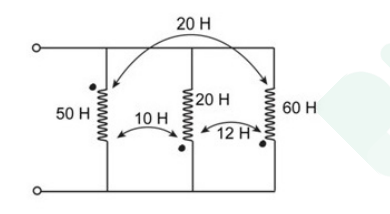
Calculate the total inductance (in H) of the circuit shown below:
A transformer has 350 primary turns and 1050 secondary turns. The primary winding is connected across a 230 V, 50 Hz supply. The induced EMF in the secondary will be


