
Which semiconductor power device, out of the following, is not a current triggered device?
MOSFET
Identifying Non-Current Triggered Semiconductor Devices
Semiconductor power devices are electronic components used to control or switch large electrical power. Many of these devices require a specific signal at their control terminal (gate) to initiate conduction. This control signal can be either a current pulse or a voltage level. The question asks us to identify the device from the given list that does not operate based on a current trigger.
Understanding Triggering Mechanisms
Let's examine the triggering mechanism for each device listed:
- Thyristor (SCR - Silicon Controlled Rectifier): A Thyristor is turned on by applying a positive pulse of current (often referred to as a gate current, $I_G$) to its gate terminal with respect to the cathode. It is a current-triggered device.
- GTO (Gate Turn-Off Thyristor): A GTO is a specific type of Thyristor that can be turned off by applying a negative gate current pulse. However, its turn-on mechanism is similar to a standard Thyristor, requiring a gate current pulse. Thus, it is also considered current-triggered for turn-on.
- TRIAC (Triode for Alternating Current): A TRIAC is essentially a bidirectional Thyristor. It can be triggered into conduction in either direction by applying a gate current pulse relative to the main terminal 1 (MT1). Therefore, it is also a current-triggered device.
- MOSFET (Metal-Oxide-Semiconductor Field-Effect Transistor): A MOSFET is fundamentally different. It is a voltage-controlled device. Conduction between the drain and source is controlled by the voltage applied between the gate and source terminals ($V_{GS}$). Since the gate is electrically insulated from the channel by a thin layer of oxide, very little to no steady-state gate current flows ($I_G \approx 0$). It relies on the electric field created by the gate voltage to control conductivity.
Device Comparison Table
The following table summarizes the triggering mechanism:
| Device | Triggering Mechanism |
|---|---|
| Thyristor | Current Triggered (Gate Current) |
| GTO | Current Triggered (Gate Current for Turn-on) |
| TRIAC | Current Triggered (Gate Current) |
| MOSFET | Voltage Controlled (Gate-Source Voltage) |
Conclusion on Triggering
Based on the analysis, the Thyristor, GTO, and TRIAC are all primarily turned on using a gate current pulse. The MOSFET, however, operates based on the gate-source voltage ($V_{GS}$) and is therefore a voltage-controlled device, not a current-triggered one.
Important Questions from Power Semiconductor Diodes and Transistors
A charger supplies 100 W at 20 V for charging the battery of a laptop. The power devices, used in the converter inside the charger, operate at a switching frequency of 200 kHz. Which power device is best suited for this purpose?
Diacs are primarily used as:
Which of the following circuit is used to obtain pulse gate triggering?
The figure shows a straight-line approximation for the forward characteristics of a power diode. A continuous on-state current of 15 A is flowing through the diode.
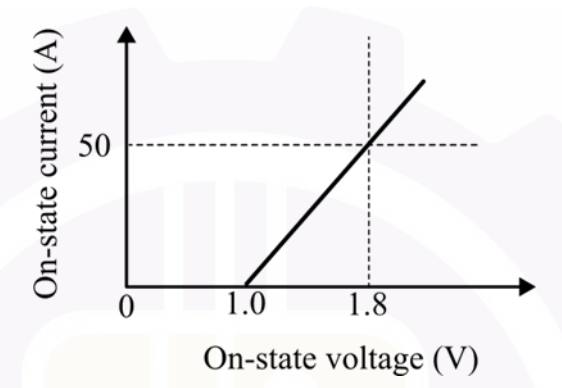
What is the power loss in the diode?
For a system with $G(S)=\frac{k}{S(S+1)(S+2)}$, $H(S)=1$. Determine the brake away point.


