
Diacs are primarily used as:
triggering devices
DIAC: Understanding Its Primary Use
A DIAC, which stands for Diode for Alternating Current, is a two-terminal, three-layer, bidirectional semiconductor device. It is specifically designed to conduct current only after its breakover voltage (\(V_{BO}\)) has been reached. Before this voltage threshold, the DIAC maintains a high-resistance (off) state. Once the voltage applied across it exceeds \(V_{BO}\) in either the positive or negative direction, the DIAC quickly switches to a low-resistance (on) state, allowing current to flow through it rapidly.
DIAC's Role as a Triggering Device
The primary and most common application of DIACs is as triggering devices. They are extensively used to provide the gate trigger pulse for other power control devices, most notably TRIACs (Triode for Alternating Current) and SCRs (Silicon Controlled Rectifiers).
- Triggering Mechanism: When the voltage across the DIAC in a circuit reaches its specified breakover voltage (\(V_{BO}\)), the DIAC suddenly turns on and conducts. This sudden turn-on creates a sharp, rapid voltage pulse across a resistor typically connected in series with the DIAC.
- Gate Pulse Generation: This sharp voltage pulse generated by the DIAC is then applied directly to the gate terminal of a TRIAC or an SCR. A sufficient pulse at the gate ensures that the TRIAC or SCR is reliably turned on, allowing it to conduct a much larger current to the connected load.
- Symmetrical Triggering: Since DIACs are bidirectional, they can conduct in both positive and negative voltage polarities. This characteristic makes them perfectly suited for triggering TRIACs, which are also bidirectional devices used for AC power control. The symmetrical switching behavior of a DIAC ensures consistent and reliable triggering of the TRIAC during both the positive and negative halves of the AC power cycle.
Common electronic applications where DIACs function as essential triggering devices include household light dimmers, adjustable motor speed control circuits, and various heating control systems. In these applications, DIACs work in conjunction with TRIACs to precisely control the AC power delivered to the load.
Why Other Options Are Not Primary Uses of DIACs
- Surge Protection Devices: While some electronic components might offer incidental protection, DIACs are not primarily designed for surge protection. Dedicated devices like Transient Voltage Suppressor (TVS) diodes or Metal Oxide Varistors (MOVs) are specifically engineered for protecting circuits from damaging voltage transients or surges.
- Power Thyristors: DIACs themselves are not classified as power thyristors. Power thyristors, such as SCRs and TRIACs, are designed to handle and control significant amounts of power and large currents. In contrast, DIACs are low-power devices whose main role is to provide the control signal (trigger pulse) to the gate of these much larger power-handling thyristors.
- Pulse Generators: Although a DIAC does generate a voltage pulse (specifically, a trigger pulse) when it breaks over, its primary use or function in the vast majority of electronic circuits is not as a general-purpose pulse generator. Instead, its function is very specifically focused on triggering other power semiconductor devices, providing the precise and reliable turn-on signal for power control applications.
Therefore, considering their fundamental operational characteristics and their widespread integration into electronic circuits, DIACs are predominantly and primarily utilized as triggering devices for power control components like TRIACs and SCRs.
Important Questions from Power Semiconductor Diodes and Transistors
Which semiconductor power device, out of the following, is not a current triggered device?
A charger supplies 100 W at 20 V for charging the battery of a laptop. The power devices, used in the converter inside the charger, operate at a switching frequency of 200 kHz. Which power device is best suited for this purpose?
Which of the following circuit is used to obtain pulse gate triggering?
The figure shows a straight-line approximation for the forward characteristics of a power diode. A continuous on-state current of 15 A is flowing through the diode.
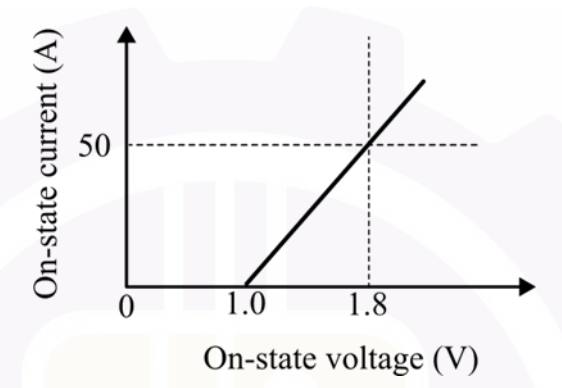
What is the power loss in the diode?
For a system with $G(S)=\frac{k}{S(S+1)(S+2)}$, $H(S)=1$. Determine the brake away point.


