
The figure shows a straight-line approximation for the forward characteristics of a power diode. A continuous on-state current of 15 A is flowing through the diode. What is the power loss in the diode?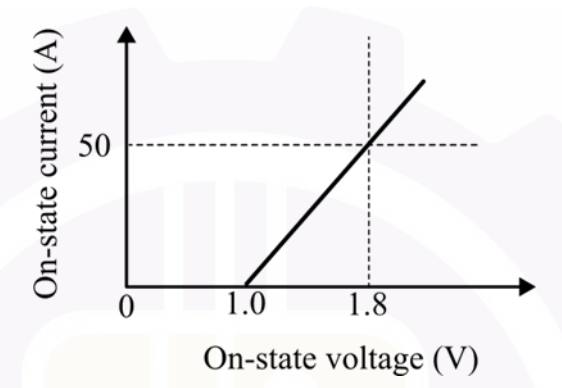
To determine the power loss in the diode, we need to calculate the product of the on-state current and the on-state voltage drop across the diode. The given figure provides details about the diode's on-state characteristics.
From the graph, we observe the following:
- The on-state voltage at 50 A is approximately \(1.8 \, \text{V}\).
- The relationship between current and voltage is linear, so we can use this ratio to find the voltage drop for 15 A.
Using the graph, the equation of the line can be approximated from the two known points: \((0, 1.0)\) V and \((50, 1.8)\) V.
The slope (m) of the line is calculated as:
\(m = \frac{(1.8 - 1.0) \, \text{V}}{(50 - 0) \, \text{A}} = \frac{0.8}{50} = 0.016 \, \text{V/A}\)
Now, we can find the voltage drop (\(V_{\text{ON}}\)) at 15 A:
\(V_{\text{ON}} = 1.0 + 0.016 \times 15 = 1.0 + 0.24 = 1.24 \, \text{V}\)
The power loss (\(P_{\text{loss}}\)) in the diode is given by:
\(P_{\text{loss}} = I_{\text{ON}} \times V_{\text{ON}}\)
\(P_{\text{loss}} = 15 \, \text{A} \times 1.24 \, \text{V} = 18.6 \, \text{W}\)
Therefore, the power loss in the diode is 18.6 W.
Important Questions from Power Semiconductor Diodes and Transistors
Which semiconductor power device, out of the following, is not a current triggered device?
A charger supplies 100 W at 20 V for charging the battery of a laptop. The power devices, used in the converter inside the charger, operate at a switching frequency of 200 kHz. Which power device is best suited for this purpose?
Diacs are primarily used as:
Which of the following circuit is used to obtain pulse gate triggering?
For a system with $G(S)=\frac{k}{S(S+1)(S+2)}$, $H(S)=1$. Determine the brake away point.


