Understanding Niche Partitioning in Species
Niche partitioning refers to the process by which competing species use the environment differently in a way that helps them to coexist. This involves dividing a shared resource, thus reducing direct competition.
Analysis of Options for Niche Partitioning
- Temporal separation of activity: This means species use the same resource but at different times (e.g., day vs. night activity). This is a valid example of niche partitioning as it reduces direct encounters and competition.
- Diet specialization: Species consuming different food sources is a clear way to partition resources, lessening competition for food. This is a key aspect of niche partitioning.
- Hybridization: This occurs when different species interbreed. It typically indicates a breakdown in reproductive isolation rather than a mechanism for coexistence through resource division. It is not an example of niche partitioning.
- Vertical stratification of foraging heights: Species utilizing different vertical layers or heights within an environment (like different levels in a forest canopy) to forage is a spatial partitioning of resources, a classic example of niche partitioning.
Conclusion on Niche Partitioning Examples
Based on the analysis, options A, B, and D represent effective strategies for niche partitioning, allowing species to coexist by minimizing direct competition.
Important Questions from Niche
- Species 1 and 2 belong to the same genus and co-occur at the same site. Which one or more of the following strategies would facilitate their coexistence at the site?
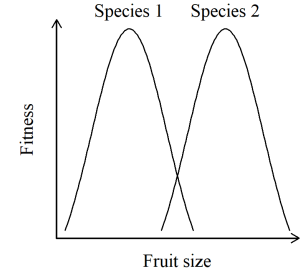
Two species of fruit bats (Species 1 and Species 2) eat fruits of varying sizes. The curves shown represent the ecological niche for these two species. If the curves for both species were to completely overlap, which one or more of the statements given would be correct?
The abundances of three species (P, Q, and R) were measured along a resource gradient. The resultant pattern is summarized in the figure. Which of the following statements can be inferred from niche theory?
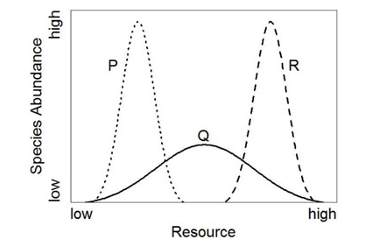
- Assume that the abundance of a species in a community is proportional to the size of its niche. As each new species colonises this community, an existing niche is split. The resultant relative abundances of species in this community will be most uneven if:
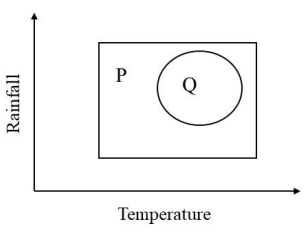
In this figure, the rectangle (P) depicts the range of temperature and rainfall in which a plant species can survive and propagate. The circle (Q) demarcates the range of temperature and rainfall in which this plant species is actually found.
Which one of the following statements about P and Q is accurate for this plant species?