Two species of fruit bats (Species 1 and Species 2) eat fruits of varying sizes. The curves shown represent the ecological niche for these two species. If the curves for both species were to completely overlap, which one or more of the statements given would be correct?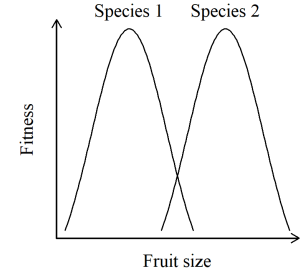
In ecology, the concept of an ecological niche describes the role a species plays in its ecosystem, including the resources it uses, the conditions it prefers, and its interactions with other species. When two species have overlapping niches, there is potential for competition.
The question states that the curves for two species of fruit bats overlap completely. Here is how we analyze the options:
-
There will be no resource competition between Species 1 and Species 2:
This statement is incorrect. If the niches completely overlap, both species use the same resources, leading to intense competition for those resources.
-
One of the species may become extinct due to competitive exclusion:
This statement is correct. The competitive exclusion principle states that two species competing for the same limiting resources cannot coexist at constant population values. One species will have a slight advantage and outcompete the other, possibly leading to the extinction of the less competitive species.
-
There will be little competition between Species 1 and Species 2:
This statement is incorrect. Complete niche overlap implies significant competition as both species rely on identical resources.
-
The two species will use identical resources:
This statement is correct. An overlap in ecological niches means both species require the same resources, leading to direct competition.
Conclusion: The correct statements are:
- One of the species may become extinct due to competitive exclusion.
- The two species will use identical resources.
Important Questions from Niche
- Species 1 and 2 belong to the same genus and co-occur at the same site. Which one or more of the following strategies would facilitate their coexistence at the site?
- Which one or more options is/are example(s) of niche partitioning between species?
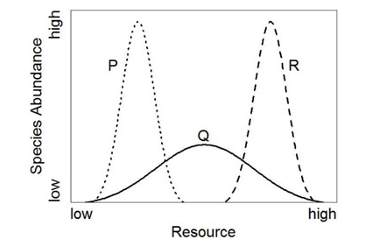
The abundances of three species (P, Q, and R) were measured along a resource gradient. The resultant pattern is summarized in the figure. Which of the following statements can be inferred from niche theory?
- Assume that the abundance of a species in a community is proportional to the size of its niche. As each new species colonises this community, an existing niche is split. The resultant relative abundances of species in this community will be most uneven if:
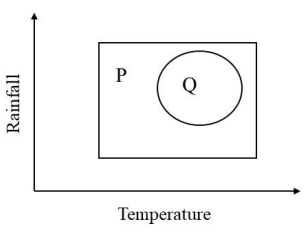
In this figure, the rectangle (P) depicts the range of temperature and rainfall in which a plant species can survive and propagate. The circle (Q) demarcates the range of temperature and rainfall in which this plant species is actually found.
Which one of the following statements about P and Q is accurate for this plant species?