Community Ecology: Niche Splitting and Species Abundance
The question explores how the distribution of species abundances becomes uneven within a community, given specific assumptions about niche size and colonization.
Key Concepts:
- Niche Size and Abundance: The problem states that species abundance is directly proportional to its niche size. A larger niche means a more abundant species.
- Niche Splitting: When a new species arrives, it occupies a niche, effectively splitting an existing one. This process alters the relative sizes (and thus abundances) of the species present.
- Uneven Distribution: This refers to a situation where a few species are highly abundant, while most species are rare.
Analyzing Niche Splitting Scenarios
To achieve the most uneven relative abundances, the colonization process must consistently reduce the relative advantage of certain species. Let's consider the impact of splitting different niche sizes:
- Splitting the Largest Niche: If the largest niche is always split, the most abundant species' niche gets smaller. This could potentially lead to a more even distribution by reducing dominance.
- Random Splitting: Randomly splitting niches might lead to unpredictable changes, not necessarily the most extreme unevenness.
- Splitting Proportional to Size: If larger niches are split more often, this might maintain the dominance of larger species or distribute the splitting effect more broadly.
- Splitting the Smallest Niche: Consistently splitting the smallest niche has a distinct effect. The smallest niches correspond to the least abundant species. Repeatedly splitting these small niches makes them even smaller. This disproportionately affects the rare species, driving their abundance down further relative to the larger, less frequently impacted niches. Consequently, the gap between the most abundant and least abundant species widens dramatically, resulting in the most uneven distribution of relative abundances.
Therefore, the most uneven relative abundances occur when the smallest niche is always targeted for splitting by incoming species.
Important Questions from Niche
- Species 1 and 2 belong to the same genus and co-occur at the same site. Which one or more of the following strategies would facilitate their coexistence at the site?
Two species of fruit bats (Species 1 and Species 2) eat fruits of varying sizes. The curves shown represent the ecological niche for these two species. If the curves for both species were to completely overlap, which one or more of the statements given would be correct?
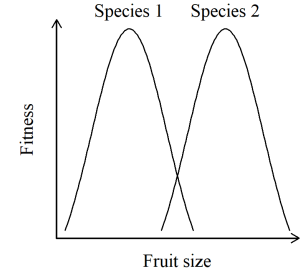
- Which one or more options is/are example(s) of niche partitioning between species?
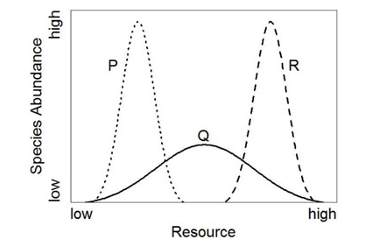
The abundances of three species (P, Q, and R) were measured along a resource gradient. The resultant pattern is summarized in the figure. Which of the following statements can be inferred from niche theory?
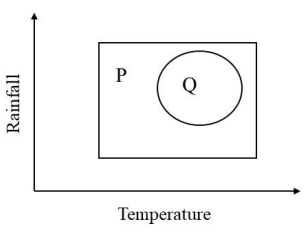
In this figure, the rectangle (P) depicts the range of temperature and rainfall in which a plant species can survive and propagate. The circle (Q) demarcates the range of temperature and rainfall in which this plant species is actually found.
Which one of the following statements about P and Q is accurate for this plant species?