
Question
Which one of the statements below best describes a plant species with the timing of reproductive events shown in the following figure? 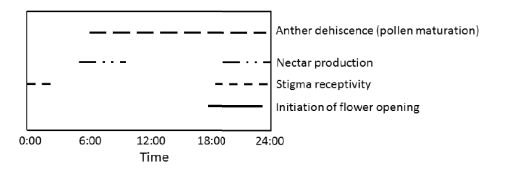
The correct answer is
The plant relies on nocturnal pollinators only
The question asks about the timing of reproductive events in a plant and which type of pollinators it relies on. Let's analyze the given figure:
From the figure, we observe the following:
- Anther dehiscence (pollen maturation): Takes place from late afternoon to late at night.
- Nectar production: Occurs in the evening and lasts through the night.
- Stigma receptivity: Starts in the evening and extends into the night.
- Initiation of flower opening: Begins in the evening and is prominent during nighttime.
All these key reproductive activities primarily occur during the evening and nighttime. This timing strongly suggests reliance on nocturnal pollinators.
Let's evaluate the given options:
- (A) The plant does not require animal pollinators: Not plausible as there is significant nectar production indicating pollinator attraction.
- (B) The plant relies on diurnal pollinators only: Incorrect, since the main activities happen at night.
- (C) The plant relies on diurnal and nocturnal pollinators: Incorrect, as the timing aligns mainly with nocturnal activity.
- (D) The plant relies on nocturnal pollinators only: Correct, as the observed timing of events aligns with nocturnal activity.
Conclusion: Based on the analysis, the right choice is (D). The plant relies on nocturnal pollinators only.
Was this answer helpful?
Important Questions from Community interactions
- A native species of butterfly at one site in North America used to feed on plant species P. In the 1960s, an exotic plant species Q was introduced at this site. The butterfly switched to feeding on Q, so much so that it was no longer found feeding on P. When the plant species Q was removed from the site in the 1990s, the butterfly species went locally extinct. Later, a population of the same butterfly species from elsewhere, that still fed on plant P, came and occupied the same site. Which one or more of the processes listed below has/have occurred here?
- Which one of the following is a result of antagonistic coevolution?
- Observations of algal species showed that their diversity was higher in pools where there were grazing snails compared to pools without snails. Which one of the following statements best explains this result?
- Which one of the following ecological processes best explains the observation thatseedling establishment increases with distance from the parent tree in a forest?
- Depending on soil nutrient availability, which one or more of the following interaction(s) can occur between soil mycorrhizal fungi and plants?
Need Expert Advice?


