Understanding Antagonistic Coevolution
Antagonistic coevolution describes an evolutionary process where two species exert selective pressures on each other, leading to adaptations and counter-adaptations. This often occurs in predator-prey, parasite-host, or herbivore-plant relationships, creating an "evolutionary arms race."
Analyzing Evolutionary Scenarios
Let's examine why certain options represent antagonistic coevolution:
- Option 1: Convergent evolution of bird wings and bat wings - This is convergence, where unrelated species develop similar traits due to similar environmental pressures (flight), not antagonistic interaction.
- Option 2: Adaptive radiation of beak shape in Darwin's finches - This is adaptive radiation, driven by diversification into available ecological niches, primarily related to food sources.
- Option 3: Caterpillars feeding on chemically-defended host plants - This is a prime example of antagonistic coevolution. The host plant evolves chemical defenses to deter herbivores. In response, caterpillars evolve mechanisms to tolerate or detoxify these chemicals, allowing them to feed on the plant. This cycle of defense and counter-defense exemplifies an evolutionary arms race.
- Option 4: Specialised morphology of orchid flowers for pollination - This is typically mutualistic coevolution, where the flower and pollinator evolve adaptations that benefit both species.
Conclusion on Antagonistic Coevolution
The interaction between caterpillars and plants with chemical defenses showcases a direct conflict and reciprocal adaptation, fitting the definition of antagonistic coevolution.
Important Questions from Community interactions
- A native species of butterfly at one site in North America used to feed on plant species P. In the 1960s, an exotic plant species Q was introduced at this site. The butterfly switched to feeding on Q, so much so that it was no longer found feeding on P. When the plant species Q was removed from the site in the 1990s, the butterfly species went locally extinct. Later, a population of the same butterfly species from elsewhere, that still fed on plant P, came and occupied the same site. Which one or more of the processes listed below has/have occurred here?
- Observations of algal species showed that their diversity was higher in pools where there were grazing snails compared to pools without snails. Which one of the following statements best explains this result?
- Which one of the following ecological processes best explains the observation thatseedling establishment increases with distance from the parent tree in a forest?
- Depending on soil nutrient availability, which one or more of the following interaction(s) can occur between soil mycorrhizal fungi and plants?
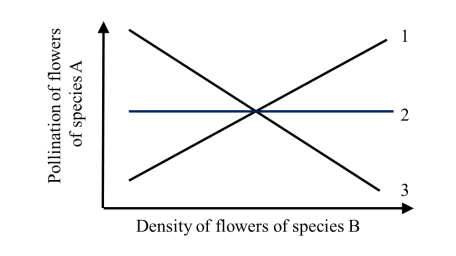
Two co-occurring plant species, A and B, flower at the same time. They are visited by the same pollinator species. If these plants are pollinator-limited, then which one or more of the following statements is/are correct with regard to the figure shown below?