Seedling Establishment Patterns
The observation that seedling establishment improves as distance from the parent tree increases suggests a negative influence of the parent tree on nearby seedlings. This pattern is best explained by competition within species (intraspecific competition).
Intraspecific Competition Explanation
Intraspecific competition happens when individuals of the same species compete for limited resources. In the context of a parent tree and its seedlings:
- High Competition Near Parent: Seedlings located very close to the parent tree compete directly with it for resources like water, nutrients, and light. The large parent tree usually has superior access to these resources, hindering seedling survival and establishment.
- Reduced Competition Further Away: As the distance from the parent tree increases, the intensity of intraspecific competition decreases. This allows seedlings a better chance to access resources and establish successfully.
Evaluation of Other Options
- Competition between species: This refers to competition between different plant species. While important in forests, it doesn't specifically explain why establishment varies with distance from the *same* parent tree.
- Facilitation between species: This involves positive interactions between different species. It would likely benefit seedlings regardless of distance from the parent or benefit seedlings near other species, not necessarily distance from the parent.
- Facilitation within species: This positive interaction among individuals of the same species would typically lead to *better* establishment *closer* to the parent tree or in groups, contradicting the observed pattern.
Therefore, reduced competition within species at greater distances explains the observed increase in seedling establishment.
Important Questions from Community interactions
- A native species of butterfly at one site in North America used to feed on plant species P. In the 1960s, an exotic plant species Q was introduced at this site. The butterfly switched to feeding on Q, so much so that it was no longer found feeding on P. When the plant species Q was removed from the site in the 1990s, the butterfly species went locally extinct. Later, a population of the same butterfly species from elsewhere, that still fed on plant P, came and occupied the same site. Which one or more of the processes listed below has/have occurred here?
- Which one of the following is a result of antagonistic coevolution?
- Observations of algal species showed that their diversity was higher in pools where there were grazing snails compared to pools without snails. Which one of the following statements best explains this result?
- Depending on soil nutrient availability, which one or more of the following interaction(s) can occur between soil mycorrhizal fungi and plants?
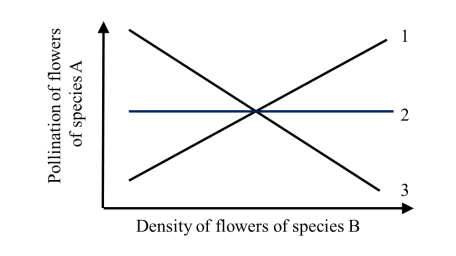
Two co-occurring plant species, A and B, flower at the same time. They are visited by the same pollinator species. If these plants are pollinator-limited, then which one or more of the following statements is/are correct with regard to the figure shown below?