Algal Diversity Explanation: Snail Grazing Effects
The observation that algal species diversity is higher in pools with grazing snails compared to pools without snails can be explained by the feeding behavior of the snails. Snails act as herbivores that can significantly influence the structure of the algal community.
Mechanism of Increased Diversity
When snails feed selectively, they can prevent dominant algal species from monopolizing resources and outcompeting less dominant species. By keeping the most abundant species in check, snails create opportunities for rarer species to persist, leading to higher overall species richness.
Analysis of Options
- Option A: Snails feed preferentially on the more abundant algal species. This statement provides the best explanation. Selective grazing on abundant species reduces their competitive advantage, allowing less abundant species to survive and thrive, thereby increasing overall diversity.
- Option B: Snails avoid feeding on algal species. This contradicts the role of grazing snails and does not explain the observed increase in diversity.
- Option C: Snails feed only on the less abundant algal species. This feeding strategy would lead to a decrease in diversity by eliminating rarer species.
- Option D: Snails feed equally on all the algal species irrespective of algal abundance. While grazing occurs, feeding equally on all species does not inherently explain why diversity would be *higher* than in the absence of snails. Preferential grazing on dominant species is a more direct mechanism for increasing diversity.
Important Questions from Community interactions
- A native species of butterfly at one site in North America used to feed on plant species P. In the 1960s, an exotic plant species Q was introduced at this site. The butterfly switched to feeding on Q, so much so that it was no longer found feeding on P. When the plant species Q was removed from the site in the 1990s, the butterfly species went locally extinct. Later, a population of the same butterfly species from elsewhere, that still fed on plant P, came and occupied the same site. Which one or more of the processes listed below has/have occurred here?
- Which one of the following is a result of antagonistic coevolution?
- Which one of the following ecological processes best explains the observation thatseedling establishment increases with distance from the parent tree in a forest?
- Depending on soil nutrient availability, which one or more of the following interaction(s) can occur between soil mycorrhizal fungi and plants?
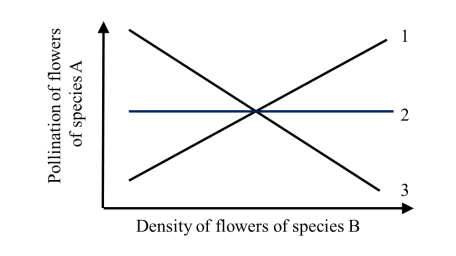
Two co-occurring plant species, A and B, flower at the same time. They are visited by the same pollinator species. If these plants are pollinator-limited, then which one or more of the following statements is/are correct with regard to the figure shown below?