
Question
Two co-occurring plant species, A and B, flower at the same time. They are visited by the same pollinator species. If these plants are pollinator-limited, then which one or more of the following statements is/are correct with regard to the figure shown below?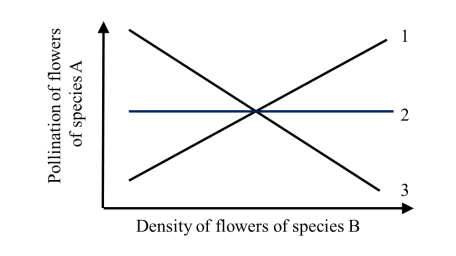
The correct answer is
Line 1 represents facilitation.
The graph shows how the pollination success of species A (y-axis) changes as the density of flowers of species B (x-axis) increases. Since both species are pollinator-limited and share the same pollinator, the interaction is related to how the presence of B influences the visits received by A.
Analysis of the Lines:
- Line 1 (Positive Slope): As the density of species B increases, the pollination success of species A increases. This positive effect is known as **Facilitation** (or sometimes Mutualism, if the effect is reciprocal, although only the effect on A is shown). This often happens if B acts as an "attractor" for the shared pollinator, drawing more pollinators into the area, which then also visit A.
- Line 2 (Zero Slope): The density of species B has no effect on the pollination success of species A. This represents **Neutralism**.
- Line 3 (Negative Slope): As the density of species B increases, the pollination success of species A decreases. This negative effect is known as **Competition** (for shared pollinator visits).
Evaluation of Options:
- Option 1: Line 1 represents competition. (Incorrect, Line 1 is facilitation.)
- Option 2: Line 2 represents mutualism. (Incorrect, Line 2 is neutralism.)
- Option 3: Line 3 represents parasitism. (Incorrect, Line 3 is competition, not parasitism.)
- Option 4: Line 1 represents facilitation. (Correct, as increasing the density of B increases the pollination success of A.)
The correct option is Option 4.
Was this answer helpful?
Important Questions from Community interactions
- A native species of butterfly at one site in North America used to feed on plant species P. In the 1960s, an exotic plant species Q was introduced at this site. The butterfly switched to feeding on Q, so much so that it was no longer found feeding on P. When the plant species Q was removed from the site in the 1990s, the butterfly species went locally extinct. Later, a population of the same butterfly species from elsewhere, that still fed on plant P, came and occupied the same site. Which one or more of the processes listed below has/have occurred here?
- Which one of the following is a result of antagonistic coevolution?
- Observations of algal species showed that their diversity was higher in pools where there were grazing snails compared to pools without snails. Which one of the following statements best explains this result?
- Which one of the following ecological processes best explains the observation thatseedling establishment increases with distance from the parent tree in a forest?
- Depending on soil nutrient availability, which one or more of the following interaction(s) can occur between soil mycorrhizal fungi and plants?
Need Expert Advice?


