
Understanding Landforms of Granitic Terrains
The question asks to identify a set of landforms that are typically found in areas dominated by granite rock, known as granitic terrains. Granite is a type of igneous rock that is generally resistant to weathering and erosion. This resistance causes it to often stand out relative to the surrounding, less resistant rocks, leading to the formation of specific geological features.
Analyzing Features of Granitic Terrains
Let's examine the characteristics of the landforms mentioned in the options to determine which set is most representative of granitic terrains:
Key Landforms in Granite Areas
Certain landforms are distinct indicators of extensive granite bedrock shaped by geological processes:
- Bornhardt: This is a large, steep-sided, dome-shaped hill composed of granite or similar resistant rock. It forms when a resistant pluton (an underground body of magma that cools slowly) is exposed by erosion, leaving it as an isolated feature rising above the landscape.
- Inselberg: Meaning "island mountain" in German, an inselberg is an isolated rocky hill or small mountain that rises abruptly from a relatively flat surrounding plain. Like bornhardts, they are erosional remnants of more resistant rock, often granite.
- Tors: Tors are masses of rock, often appearing as weathered pillars or blocks, that stand out on a hilltop or ridge. They are commonly found in granite areas and are the result of long-term weathering processes, such as jointing (cracking) and the removal of weathered debris.
- Tafoni: These are characteristic small hollows or pits found on the surface of rock outcrops, particularly common on granite. Tafoni are formed by various weathering processes, including salt crystallization, thermal expansion and contraction, and moisture cycles, which exploit weaknesses in the rock's surface.
Features Less Typical of Granite
Other landforms mentioned in the options are generally associated with different geological environments:
- Tarn: A small lake found in a mountain basin, typically of glacial origin.
- Hogback: A long, narrow ridge with a sharp crest, usually formed from eroded, tilted rock strata.
- Cuesta: A ridge with a gentle slope on one side and a steeper slope on the other, formed from eroded, tilted rock layers.
- Uvala and Polje: These are large depressions characteristic of karst landscapes, which form in soluble rocks like limestone, not typically granite.
- Mesa: A flat-topped hill with steep sides, usually formed by erosion of layered rocks (sedimentary or volcanic). While a mesa might be found in a region containing granite, the mesa itself isn't a landform created directly *from* granite erosion in the same way as an inselberg.
Based on these definitions, the set {Bornhardt, inselberg, tors, tafoni} includes features that are distinct and typical results of the weathering and erosion processes acting upon granitic terrains.
Important Questions from Geomorphology
- Match the following
A Evaporites O Ventifacts B Deflation P Desert varnish C Sandblasting Q Playa D Weathering R Desert pavement E Streamlined hills S Yardangs - Match List-I with List –II and select the correct answer using the codes given below the lists
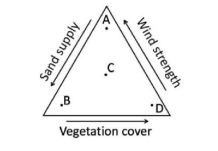
List-I List-II A Bajada P Aeolian B Dreikanter Q Desert C Karn R Glacial D Dolines S Karst Indentify the sand dune forms that are likely to develop
- If L=sediment load, $\text{D}_{50}$=median sediment size, $\bar{Q}$=mean discharge and S=slope then which one of the following relationships is correct?
- Unpaired non-cyclic river terraces are NOT associated with


