
Which one of the following figures correctly shows the path of a ray of light through a glass prism:?

CONCEPT:
- Refraction through a prism : It is the bending of light when it goes from one medium to another.
- When a ray of light passes through a glass prism, refraction of light occurs both, when it enters the prism as well as when it leaves the prism.
- Prism : It is a wedge-shaped transparent body that causes incident light to be separated by color upon exiting.
- Since "white" light is really a superposition of different wavelengths, the prism, therefore, has the effect of angularly separating the incident light by color.
Formula:
⇒ Angle of prism (A) = r 1 + r 2
where r 1 = Angle of refraction at phase one, r 2 = Angle of refraction at phase two.
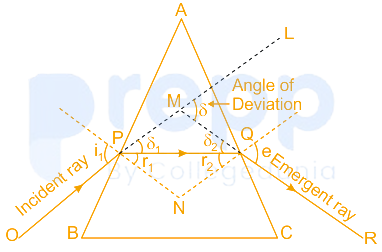
EXPLANATION :

- When a ray of light passes through a prism, it undergoes refraction two times .
- The first time when a ray of light passes from rarer to the denser medium of glass , it bends towards normal which is towards the base of the prism.
- The second time the ray of light passed from denser to rarer medium, i.e., glass to air, and it bends away from the normal , i.e., towards the base of the prism and it is happening only in the first case. Therefore option 1 is correct.
Similar Questions
A rainbow is produced due to which one of the following phenomenon?
Consider the following statements about a microscope and a telescope:
1. Both the eyepiece and the objective of a microscope are convex lenses.
2. The focal length of the objective of a telescope is larger than the focal length of its eyepiece.
3. The magnification of a telescope increases with the increase in focal length of its objective.
4. The magnification of a microscope increases with the increase in focal length of its objective.
Which of the statements given above are correct?Tyndall effect is a phenomenon of
Power of a lens of focal length 25 cm is
When a light beam falls on a triangular glass prism, a band of colours is obtained. Which one of the following statements is correct in this regard ?
If the focal length of a convex lens is 50 cm, which one of the following is its power?
The refractive indices of two media are denoted by n 1and n 2, and the velocities of light in these two media are respectively v 1and v 2. If n 2/n 1is 1.5, which one of the following statements is correct?
Which one of the following statements is correct for a plane mirror?
An object is placed in front of a convex mirror. Which one of the following statements is correct?
- The twinkling of a star is due to the atmospheric
Important Questions from Refraction and Reflection
A convex lens of focal length f will form a magnified real image of an object, if the object is placed.
A ray of light travelling in the direction \(\frac{1}{2} (\hat i + \sqrt 3 \hat j)\) is incident on a plane mirror. After reflection it travels along the direction \(\frac{1}{2} (\hat i - \sqrt 3 \hat j)\) The angle of incidence is:
Twinkling of stars is due to atmospheric
An optical fibre has a core material of refractive index of 1.55 and cladding material of refractive index of 1.50. The numerical aperture of the fibre is
- The refracting angle of a prism is $A$. The refractive index of the material of the prism is $\frac{1+\cos A}{\sin A}$. The angle of minimum deviation is:



