A. $\text{Si}_{4}\text{H}_{10}$
B. $\text{Si}_{3}\text{H}_{8}$
C. $\text{Si}_{5}\text{H}_{10}$
D. $\text{Si}_{6}\text{H}_{14}$
E. $\text{Si}_{7}\text{H}_{9}$
Choose the correct answer from the options given below :
Reaction of Magnesium Silicide with Sulfuric Acid
The reaction between magnesium silicide ($\text{Mg}_{2}\text{Si}$) and sulfuric acid ($\text{H}_{2}\text{SO}_{4}$) produces a mixture of silicon-hydrogen compounds known as silanes. The general reaction involves the decomposition of the silicide by the acid to form hydrogen and silanes.
Analyzing Silane Product Formation
Silanes are a class of compounds containing only silicon and hydrogen. The simplest is monosilane ($\text{SiH}_{4}$). Higher silanes, with silicon-silicon bonds, can also form. These compounds often follow general formulas:
- Saturated silanes: $\text{Si}_{n}\text{H}_{2n+2}$ (analogous to alkanes)
- Unsaturated silanes: $\text{Si}_{n}\text{H}_{2n}$ (analogous to alkenes)
Evaluating the Silane Options
Let's examine the given options based on typical silane structures and known products from metal silicide reactions:
- A. $\text{Si}_{4}\text{H}_{10}$: This fits the saturated silane formula $\text{Si}_{n}\text{H}_{2n+2}$ ($n=4$). It is a known higher silane that can be formed.
- B. $\text{Si}_{3}\text{H}_{8}$: This also fits the saturated silane formula $\text{Si}_{n}\text{H}_{2n+2}$ ($n=3$). It is commonly observed among the higher silanes produced.
- C. $\text{Si}_{5}\text{H}_{10}$: This formula suggests an unsaturated silane $\text{Si}_{n}\text{H}_{2n}$ ($n=5$). While silanes can exhibit unsaturation, saturated higher silanes are generally more characteristic products from this specific reaction.
- D. $\text{Si}_{6}\text{H}_{14}$: This fits the saturated silane formula $\text{Si}_{n}\text{H}_{2n+2}$ ($n=6$). Formation of such higher saturated silanes is plausible.
- E. $\text{Si}_{7}\text{H}_{9}$: This formula does not conform to the standard saturated ($\text{Si}_{n}\text{H}_{2n+2}$) or unsaturated ($\text{Si}_{n}\text{H}_{2n}$) patterns for simple silanes and is unlikely to be a product.
Conclusion on Silane Products
The reaction of magnesium silicide with sulfuric acid is known to produce a mixture primarily containing monosilane and various higher, saturated silanes. Considering the standard formulas and common reaction outcomes, $\text{Si}_{4}\text{H}_{10}$ (A), $\text{Si}_{3}\text{H}_{8}$ (B), and $\text{Si}_{6}\text{H}_{14}$ (D) are the most likely products among the options provided. Options C and E represent less common or structurally inconsistent silanes for this particular reaction.
Similar Questions
- Given below are two statements : one is labelled as Assertion (A) and the other is labelled as Reason (R).
Assertion (A) : Boiling point of cis isomers is higher than trans isomers.
Reason (R) : The Dipole moment of cis isomers is higher than trans isomers.
In the light of the above statements, choose the most appropriate answer from the options given below : - Choose the correct sequence on the basis of number of unpaired electrons present in the given field :
A. $\text{Cr (+ II)}$ in weak field
B. $\text{Co (+ II)}$ in strong field
C. $\text{Ni (+ II)}$ in strong field
D. $\text{Pt (+ II)}$ in weak field
E. $\text{Ag (+ II)}$ in strong field
Choose the correct answer from the options given below : - Choose the correct sequence of the elements arranged in their increasing order of atomic numbers:
A. Pu
B. Po
C. Pm
D. Pt
E. Pa
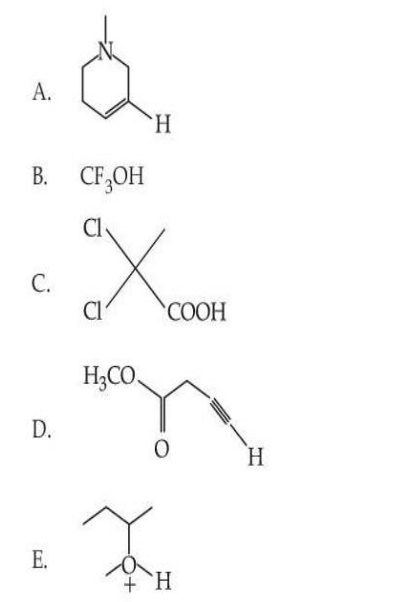
Choose the correct answer from the options given below : Arrange the Hydrogen of the following compounds from most acidic to least acidic :
Choose the correct answer from the options given below :- Which of the following molecules possess V-shape ?
A. $\text{O}_{3}$
B. $\text{N}_{3}^{-}$
C. $\text{CO}_{3}^{2-}$
D. $\text{NO}_{2}^{-}$
E. $\text{NO}_{3}^{-}$
Choose the most appropriate answer from the options given below : - The known per-oxoacids of Sulphur are :
A. $\text{H}_{2}\text{SO}_{5}$
B. $\text{H}_{2}\text{S}_{2}\text{O}_{9}$
C. $\text{H}_{3}\text{S}_{4}\text{O}_{12}$
D. $\text{H}_{2}\text{S}_{2}\text{O}_{8}$
E. $\text{H}_{2}\text{S}_{2}\text{O}_{7}$
Choose the correct answer from the options given below : - Which of the following conditions should be met while writing the canonical structures of a resonance hybrid ?
A. The magnitude of resonance energy should be low and the hybrid will be more stable
B. The number of unpaired electrons should be same in all the canonical forms
C. Canonical forms where similar charges develop on vicinal atoms are highly significant forms
D. The positions of the nuclei of each canonical form and the hybrid must remain same
E. Only a pair of electrons should be shifted in writing the canonical forms
Choose the correct answer from the options given below : - Match List - I with List - II. Match the number of d-electrons and CFSE in tetrahedral complexes (ignore pairing)
List - I
(Number of d-electrons)List - II
(CFSE)A. $\text{d}^{6}$ I. $-0.4$ B. $\text{d}^{4}$ II. $-1.2$ C. $\text{d}^{7}$ III. $-0.8$ D. $\text{d}^{8}$ IV. $-0.6$
Choose the correct answer from the options given below : - Match List - I with List - II.
List - I List - II A. Root mean square speed I. $(8 \text{ kT}/\pi\mu)^{1/2}$ B. Mean speed II. $(8 \text{ RT}/\pi\text{M})^{1/2}$ C. Most probable speed III. $(3 \text{ RT}/\text{M})^{1/2}$ D. Mean relative speed IV. $(2 \text{ RT}/\text{M})^{1/2}$
Choose the correct answer from the options given below : - During ion-implantation, the impurity atoms entering the crystal, gives up their energy to the lattice via collisions. These impurity atoms come to rest at certain average penetration depth known as :
Important Questions from Miscellaneous
- Which of the following relationships is/are not true?
(A). Most probable velocity = $\sqrt{\frac{2RT}{M}}$
(B). PV = $\frac{3}{2}kT$
(C). Compressibility factor Z = $\frac{pV}{nRT}$
(D). Average kinetic energy of gas = $\frac{1}{2}kT$
Choose the correct answer from the options given below - Match List-I with List-II
List-I List-II Electronic Configuration First Ionisation energy (kJ mol$^{-1}$) (A). ns$^2$ (I). 2100 (B). ns$^2$np$^1$ (II). 1400 (C). ns$^2$np$^3$ (III). 800 (D). ns$^2$np$^6$ (IV). 900
Choose the correct answer from the options given below: - The shielding constant of a 2p electron (calculated using Slater's rules) is
- Match List-I with List-II
List-I List-II Spectroscopy Property (A). Raman (I). Polarizability (B). FTIR (II). Dipole Moment (C). UV-Visible (III). Absorbance (D). NMR (IV). Spin
Choose the correct answer from the options given below: - The structure of protein comprises of:
(A). Primary structure of protein is associated with amino acids
(B). Secondary structure of protein is associated to peptides
(C). Tertiary structure of protein is associated with polypeptide chains
(D). Quaternary structure of protein is associated with polypeptide chains
Choose the correct answer from the options given below: