The question asks for the term that describes the average depth at which impurity atoms come to rest after losing energy through collisions during ion implantation into a crystal lattice.
Ion Implantation Process Overview
Ion implantation is a process used to introduce impurity atoms (dopants) into a material, typically a semiconductor crystal. Energetic ions of the impurity are directed towards the crystal surface.
Energy Loss and Stopping Mechanism
As the impurity ions penetrate the crystal lattice, they collide with the atoms of the crystal. During these collisions, the ions transfer their kinetic energy to the lattice atoms, gradually slowing down.
- Collisions cause energy transfer from the implanted ion to the crystal lattice.
- This energy loss leads to the deceleration of the impurity ions.
- The ions eventually come to rest within the crystal.
Defining the Average Penetration Depth
The depth at which these impurity atoms stop varies due to the probabilistic nature of atomic collisions. However, there is an average depth characteristic of the process under specific conditions.
This average depth, measured along the direction of incidence, is referred to as the Projected Range.
Analyzing the Options
- Straggle: This term describes the variation or spread in the depth distribution of the implanted ions, not the average depth.
- Diffusion Range: Diffusion is a different physical process and not the primary term for the stopping depth in ion implantation.
- Epitaxial Range: Epitaxy relates to crystal growth and is unrelated to the stopping depth of implanted ions.
- Projected Range: This precisely defines the average depth where implanted ions come to rest after losing energy.
Therefore, the average penetration depth where impurity atoms come to rest is known as the Projected Range.
Similar Questions
- Given below are two statements : one is labelled as Assertion (A) and the other is labelled as Reason (R).
Assertion (A) : Boiling point of cis isomers is higher than trans isomers.
Reason (R) : The Dipole moment of cis isomers is higher than trans isomers.
In the light of the above statements, choose the most appropriate answer from the options given below : - Choose the correct sequence on the basis of number of unpaired electrons present in the given field :
A. $\text{Cr (+ II)}$ in weak field
B. $\text{Co (+ II)}$ in strong field
C. $\text{Ni (+ II)}$ in strong field
D. $\text{Pt (+ II)}$ in weak field
E. $\text{Ag (+ II)}$ in strong field
Choose the correct answer from the options given below : - Choose the correct sequence of the elements arranged in their increasing order of atomic numbers:
A. Pu
B. Po
C. Pm
D. Pt
E. Pa
Choose the correct answer from the options given below : Arrange the Hydrogen of the following compounds from most acidic to least acidic :
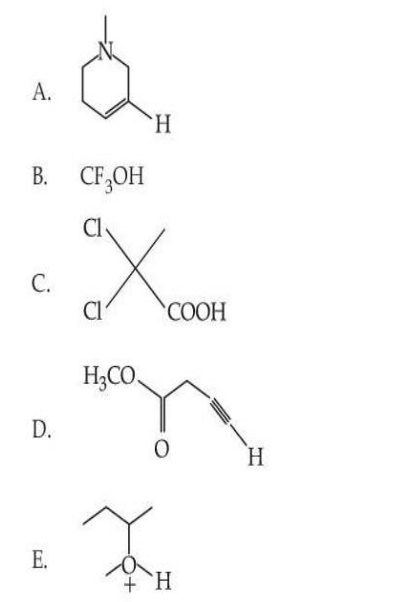
Choose the correct answer from the options given below :- Which of the following molecules possess V-shape ?
A. $\text{O}_{3}$
B. $\text{N}_{3}^{-}$
C. $\text{CO}_{3}^{2-}$
D. $\text{NO}_{2}^{-}$
E. $\text{NO}_{3}^{-}$
Choose the most appropriate answer from the options given below : - Which of the silanes are formed by the reactions of $\text{Mg}_{2}\text{Si}+\text{H}_{2}\text{SO}_{4} \longrightarrow$
A. $\text{Si}_{4}\text{H}_{10}$
B. $\text{Si}_{3}\text{H}_{8}$
C. $\text{Si}_{5}\text{H}_{10}$
D. $\text{Si}_{6}\text{H}_{14}$
E. $\text{Si}_{7}\text{H}_{9}$
Choose the correct answer from the options given below : - The known per-oxoacids of Sulphur are :
A. $\text{H}_{2}\text{SO}_{5}$
B. $\text{H}_{2}\text{S}_{2}\text{O}_{9}$
C. $\text{H}_{3}\text{S}_{4}\text{O}_{12}$
D. $\text{H}_{2}\text{S}_{2}\text{O}_{8}$
E. $\text{H}_{2}\text{S}_{2}\text{O}_{7}$
Choose the correct answer from the options given below : - Which of the following conditions should be met while writing the canonical structures of a resonance hybrid ?
A. The magnitude of resonance energy should be low and the hybrid will be more stable
B. The number of unpaired electrons should be same in all the canonical forms
C. Canonical forms where similar charges develop on vicinal atoms are highly significant forms
D. The positions of the nuclei of each canonical form and the hybrid must remain same
E. Only a pair of electrons should be shifted in writing the canonical forms
Choose the correct answer from the options given below : - Match List - I with List - II. Match the number of d-electrons and CFSE in tetrahedral complexes (ignore pairing)
List - I
(Number of d-electrons)List - II
(CFSE)A. $\text{d}^{6}$ I. $-0.4$ B. $\text{d}^{4}$ II. $-1.2$ C. $\text{d}^{7}$ III. $-0.8$ D. $\text{d}^{8}$ IV. $-0.6$
Choose the correct answer from the options given below : - Match List - I with List - II.
List - I List - II A. Root mean square speed I. $(8 \text{ kT}/\pi\mu)^{1/2}$ B. Mean speed II. $(8 \text{ RT}/\pi\text{M})^{1/2}$ C. Most probable speed III. $(3 \text{ RT}/\text{M})^{1/2}$ D. Mean relative speed IV. $(2 \text{ RT}/\text{M})^{1/2}$
Choose the correct answer from the options given below :
Important Questions from Miscellaneous
- Which of the following relationships is/are not true?
(A). Most probable velocity = $\sqrt{\frac{2RT}{M}}$
(B). PV = $\frac{3}{2}kT$
(C). Compressibility factor Z = $\frac{pV}{nRT}$
(D). Average kinetic energy of gas = $\frac{1}{2}kT$
Choose the correct answer from the options given below - Match List-I with List-II
List-I List-II Electronic Configuration First Ionisation energy (kJ mol$^{-1}$) (A). ns$^2$ (I). 2100 (B). ns$^2$np$^1$ (II). 1400 (C). ns$^2$np$^3$ (III). 800 (D). ns$^2$np$^6$ (IV). 900
Choose the correct answer from the options given below: - The shielding constant of a 2p electron (calculated using Slater's rules) is
- Match List-I with List-II
List-I List-II Spectroscopy Property (A). Raman (I). Polarizability (B). FTIR (II). Dipole Moment (C). UV-Visible (III). Absorbance (D). NMR (IV). Spin
Choose the correct answer from the options given below: - The structure of protein comprises of:
(A). Primary structure of protein is associated with amino acids
(B). Secondary structure of protein is associated to peptides
(C). Tertiary structure of protein is associated with polypeptide chains
(D). Quaternary structure of protein is associated with polypeptide chains
Choose the correct answer from the options given below: