A. The magnitude of resonance energy should be low and the hybrid will be more stable
B. The number of unpaired electrons should be same in all the canonical forms
C. Canonical forms where similar charges develop on vicinal atoms are highly significant forms
D. The positions of the nuclei of each canonical form and the hybrid must remain same
E. Only a pair of electrons should be shifted in writing the canonical forms
Choose the correct answer from the options given below :
Rules for Writing Resonance Structures
Resonance structures, also known as canonical forms, are multiple Lewis structures that collectively represent the electron delocalization within a molecule. Several conditions must be met for valid resonance structures:
Validating Canonical Form Conditions
- Condition B: Number of Unpaired Electrons
The total number of electrons, including unpaired ones, must remain constant across all resonance structures. Resonance involves the movement of electron pairs (lone pairs or pi electrons), not the creation or destruction of electrons.
- Condition D: Positions of Nuclei
The arrangement of atomic nuclei must be identical in all resonance structures and the resonance hybrid. Resonance only accounts for the delocalization of electrons, not the movement or rearrangement of atoms.
- Condition E: Electron Pair Shifts
Only pi electrons (in double/triple bonds) and non-bonding valence electrons (lone pairs) can be delocalized. Sigma bonds remain intact. This movement typically involves pairs of electrons.
Invalidating Non-Essential Conditions
- Condition A: Magnitude of Resonance Energy
A *larger* magnitude of resonance energy indicates *greater* stability of the hybrid, not lower. Resonance energy is the difference between the actual hybrid's energy and that of the most stable hypothetical contributing structure. A significant difference implies stabilization.
- Condition C: Similar Charges on Vicinal Atoms
While resonance can involve charge separation, developing similar charges (e.g., two positive charges or two negative charges) on adjacent (vicinal) atoms typically results in less stable canonical forms. Highly significant forms usually minimize such unfavorable charge arrangements.
Conclusion on Resonance Rules
Based on the analysis, the essential conditions for writing valid canonical structures are that the number of unpaired electrons must be the same (B), the positions of the nuclei must remain unchanged (D), and only pairs of electrons should be shifted (E). Therefore, options B, D, and E must be met.
Similar Questions
- Given below are two statements : one is labelled as Assertion (A) and the other is labelled as Reason (R).
Assertion (A) : Boiling point of cis isomers is higher than trans isomers.
Reason (R) : The Dipole moment of cis isomers is higher than trans isomers.
In the light of the above statements, choose the most appropriate answer from the options given below : - Choose the correct sequence on the basis of number of unpaired electrons present in the given field :
A. $\text{Cr (+ II)}$ in weak field
B. $\text{Co (+ II)}$ in strong field
C. $\text{Ni (+ II)}$ in strong field
D. $\text{Pt (+ II)}$ in weak field
E. $\text{Ag (+ II)}$ in strong field
Choose the correct answer from the options given below : - Choose the correct sequence of the elements arranged in their increasing order of atomic numbers:
A. Pu
B. Po
C. Pm
D. Pt
E. Pa
Choose the correct answer from the options given below : Arrange the Hydrogen of the following compounds from most acidic to least acidic :
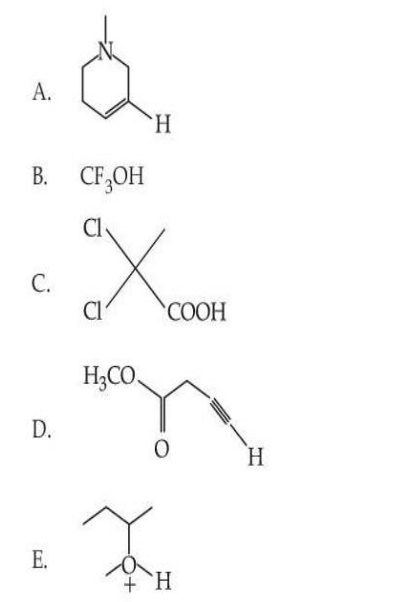
Choose the correct answer from the options given below :- Which of the following molecules possess V-shape ?
A. $\text{O}_{3}$
B. $\text{N}_{3}^{-}$
C. $\text{CO}_{3}^{2-}$
D. $\text{NO}_{2}^{-}$
E. $\text{NO}_{3}^{-}$
Choose the most appropriate answer from the options given below : - Which of the silanes are formed by the reactions of $\text{Mg}_{2}\text{Si}+\text{H}_{2}\text{SO}_{4} \longrightarrow$
A. $\text{Si}_{4}\text{H}_{10}$
B. $\text{Si}_{3}\text{H}_{8}$
C. $\text{Si}_{5}\text{H}_{10}$
D. $\text{Si}_{6}\text{H}_{14}$
E. $\text{Si}_{7}\text{H}_{9}$
Choose the correct answer from the options given below : - The known per-oxoacids of Sulphur are :
A. $\text{H}_{2}\text{SO}_{5}$
B. $\text{H}_{2}\text{S}_{2}\text{O}_{9}$
C. $\text{H}_{3}\text{S}_{4}\text{O}_{12}$
D. $\text{H}_{2}\text{S}_{2}\text{O}_{8}$
E. $\text{H}_{2}\text{S}_{2}\text{O}_{7}$
Choose the correct answer from the options given below : - Match List - I with List - II. Match the number of d-electrons and CFSE in tetrahedral complexes (ignore pairing)
List - I
(Number of d-electrons)List - II
(CFSE)A. $\text{d}^{6}$ I. $-0.4$ B. $\text{d}^{4}$ II. $-1.2$ C. $\text{d}^{7}$ III. $-0.8$ D. $\text{d}^{8}$ IV. $-0.6$
Choose the correct answer from the options given below : - Match List - I with List - II.
List - I List - II A. Root mean square speed I. $(8 \text{ kT}/\pi\mu)^{1/2}$ B. Mean speed II. $(8 \text{ RT}/\pi\text{M})^{1/2}$ C. Most probable speed III. $(3 \text{ RT}/\text{M})^{1/2}$ D. Mean relative speed IV. $(2 \text{ RT}/\text{M})^{1/2}$
Choose the correct answer from the options given below : - During ion-implantation, the impurity atoms entering the crystal, gives up their energy to the lattice via collisions. These impurity atoms come to rest at certain average penetration depth known as :
Important Questions from Miscellaneous
- Which of the following relationships is/are not true?
(A). Most probable velocity = $\sqrt{\frac{2RT}{M}}$
(B). PV = $\frac{3}{2}kT$
(C). Compressibility factor Z = $\frac{pV}{nRT}$
(D). Average kinetic energy of gas = $\frac{1}{2}kT$
Choose the correct answer from the options given below - Match List-I with List-II
List-I List-II Electronic Configuration First Ionisation energy (kJ mol$^{-1}$) (A). ns$^2$ (I). 2100 (B). ns$^2$np$^1$ (II). 1400 (C). ns$^2$np$^3$ (III). 800 (D). ns$^2$np$^6$ (IV). 900
Choose the correct answer from the options given below: - The shielding constant of a 2p electron (calculated using Slater's rules) is
- Match List-I with List-II
List-I List-II Spectroscopy Property (A). Raman (I). Polarizability (B). FTIR (II). Dipole Moment (C). UV-Visible (III). Absorbance (D). NMR (IV). Spin
Choose the correct answer from the options given below: - The structure of protein comprises of:
(A). Primary structure of protein is associated with amino acids
(B). Secondary structure of protein is associated to peptides
(C). Tertiary structure of protein is associated with polypeptide chains
(D). Quaternary structure of protein is associated with polypeptide chains
Choose the correct answer from the options given below: