
Which of the following types is best suited to represent the logical values?
Boolean
Understanding Data Types for Logical Values
In computer programming and logic, logical values are fundamental concepts used to represent truth or falsity. These values are often referred to as boolean values, named after mathematician George Boole.
When choosing a data type to represent these logical values, the goal is to select the type that is most appropriate, efficient, and semantically correct for the purpose. Let's examine the given options:
Analyzing Data Type Options
- Double: This data type is used to represent floating-point numbers, which are numbers with fractional parts (e.g., 3.14, -0.001). It is primarily used for mathematical calculations involving decimals. A double cannot directly represent a logical state like true or false.
- Character: This data type is used to represent a single character, such as a letter ('A'), a digit ('7'), or a symbol ('$'). While one *could* invent conventions like 'T' for true and 'F' for false, the character type itself does not intrinsically understand logical values.
- Integer: This data type is used to represent whole numbers (e.g., -5, 0, 100). In some programming contexts, integers are sometimes used to represent boolean values (commonly 0 for false and 1 for true). However, this is an implicit convention rather than a native representation. Using integers for logical values can sometimes lead to confusion or errors if the integer is used in an arithmetic context.
- Boolean: This data type is specifically designed to represent the two logical states: true and false. It is the native and most appropriate type for storing and manipulating logical values directly. Most programming languages provide a built-in boolean type with explicit values like
trueandfalse.
Based on the purpose of representing logical values, the data type specifically created for this is the Boolean type.
Comparison of Data Types for Logical Representation
| Data Type | Primary Purpose | Suitability for Logical Values | Reason |
|---|---|---|---|
| Double | Floating-point numbers | Not suitable | Represents numbers with decimals, not truth states. |
| Character | Single characters | Not suitable | Represents characters; requires convention for logical meaning. |
| Integer | Whole numbers | Indirect/Possible (by convention) | Represents numbers; requires convention (like 0/1) for logical meaning, not its primary purpose. |
| Boolean | Logical truth values (true/false) | Best suited | Specifically designed to represent true and false states. |
Therefore, the Boolean data type is the best choice for representing logical values because it is designed for this specific purpose and explicitly represents the states of true and false.
Conclusion on Logical Value Representation
The most direct and semantically clear way to represent logical values is by using the data type that is specifically designed for them. Among the given options, the Boolean type fits this description perfectly.
The correct type best suited to represent logical values is Boolean.
Revision Table: Key Data Types
| Data Type | Description | Examples |
|---|---|---|
| Integer | Whole numbers (positive, negative, or zero) | \(5, -100, 0\) |
| Double / Float | Numbers with decimal points | \(3.14, -0.001, 2.0\) |
| Character | A single letter, digit, or symbol | 'A', '7', '?', '\n' |
| Boolean | Logical values indicating truth or falsity | true, false |
Additional Information on Boolean Logic
Boolean logic forms the basis of digital circuits and programming logic. It deals with operations on boolean values. Common boolean operations include:
- AND: Result is true only if both operands are true.
- OR: Result is true if at least one operand is true.
- NOT: Inverts the logical value (true becomes false, false becomes true).
Boolean expressions are widely used in control flow statements (like if conditions and while loops) to determine which code blocks should be executed.
Important Questions from Logic Gates and Boolean Algebra
The number of distinct Boolean expressions of four variables is-
In the given circuit, if the input voltage lies between +E1 and -E2, then output is zero.
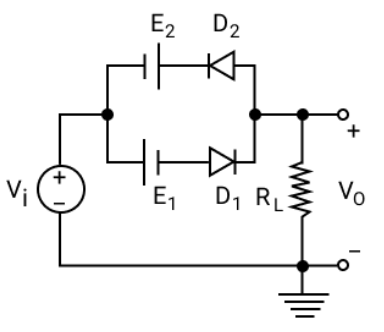
Input and output characteristics are shown below.
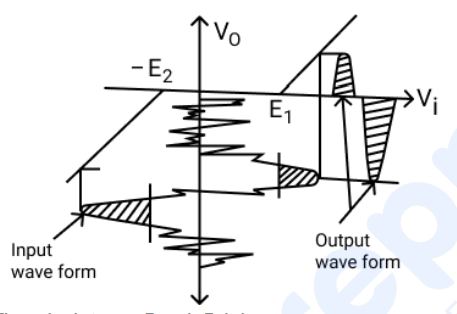
The region between +E1 and -E2 is known as _____.
The minimum number of 2-input NAND gates required to realize the logic function $Y = AB + \bar A \bar B$ is
A*B*A, where * represents XOR, is equal to:
The theorem to which the given two powerful laws in Boolean algebra belong to, is:
Law 1:\(\overline{A + B} = \overline A \ \overline B\)
Law 2:\(\overline{A B} = \overline A \ + \overline B\)


