
The theorem to which the given two powerful laws in Boolean algebra belong to, is: Law 1:\(\overline{A + B} = \overline A \ \overline B\) Law 2:\(\overline{A B} = \overline A \ + \overline B\)
De Morgan's theorem
The question presents two fundamental laws in Boolean algebra and asks to identify the theorem to which they belong. These laws are cornerstone principles used extensively in digital electronics and logic design for simplifying Boolean expressions.
De Morgan's Theorem in Boolean Algebra
The two powerful laws provided are indeed known as De Morgan's Laws, which are part of De Morgan's Theorem. This theorem is named after the British mathematician Augustus De Morgan. It provides a way to relate conjunctions (AND operations) and disjunctions (OR operations) with negations.
De Morgan's First Law Explained
The first law states that the complement (negation) of a sum (OR operation) of variables is equivalent to the product (AND operation) of the complements (negations) of those individual variables. In simpler terms, if you negate an "A OR B" statement, it's the same as having a "NOT A" AND "NOT B" statement.
- Mathematical Representation: \(\overline{A + B} = \overline A \ \overline B\)
- Interpretation: NOT (A OR B) is equal to (NOT A) AND (NOT B).
De Morgan's Second Law Explained
The second law states that the complement (negation) of a product (AND operation) of variables is equivalent to the sum (OR operation) of the complements (negations) of those individual variables. This means that if you negate an "A AND B" statement, it's the same as having a "NOT A" OR "NOT B" statement.
- Mathematical Representation: \(\overline{A B} = \overline A \ + \overline B\)
- Interpretation: NOT (A AND B) is equal to (NOT A) OR (NOT B).
These two De Morgan's Laws are vital for simplifying complex Boolean expressions, converting between different forms of logic circuits, and proving the equivalence of logical statements in digital electronics and computer science.
Understanding Other Boolean Algebra Theorems
It's important to differentiate De Morgan's Theorem from other concepts in Boolean algebra:
- Included Factor Theorem: This is not a standard or recognized theorem within the widely accepted framework of Boolean algebra.
- Transposition Theorem: This term is not typically used to describe a fundamental theorem in Boolean algebra related to the negation of sums or products.
- Consensus Theorem: The Consensus Theorem is another significant rule in Boolean algebra, often used for simplifying expressions by eliminating redundant terms. It states that for any three Boolean variables X, Y, and Z, the expression \(XY + \overline XZ + YZ\) can be simplified to \(XY + \overline XZ\). This theorem is different from De Morgan's Laws, which specifically deal with the negation of operations.
Therefore, the two powerful laws concerning the negation of sums and products are definitively part of De Morgan's Theorem, a fundamental concept in Boolean algebra.
Important Questions from Logic Gates and Boolean Algebra
The number of distinct Boolean expressions of four variables is-
Which of the following types is best suited to represent the logical values?
In the given circuit, if the input voltage lies between +E1 and -E2, then output is zero.
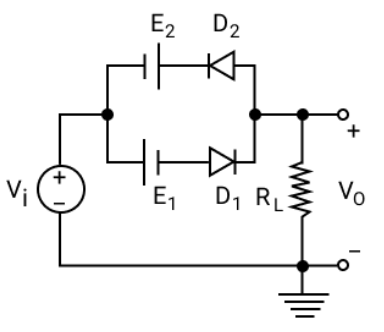
Input and output characteristics are shown below.
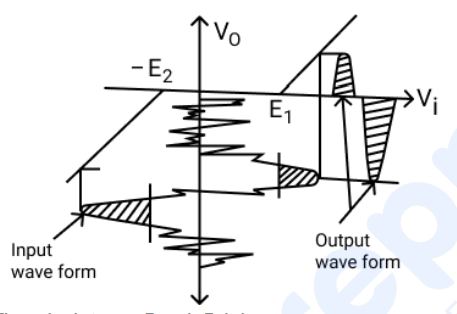
The region between +E1 and -E2 is known as _____.
The minimum number of 2-input NAND gates required to realize the logic function $Y = AB + \bar A \bar B$ is
A*B*A, where * represents XOR, is equal to:


