
In the given circuit, if the input voltage lies between +E1 and -E2, then output is zero. Input and output characteristics are shown below. The region between +E1 and -E2 is known as _____.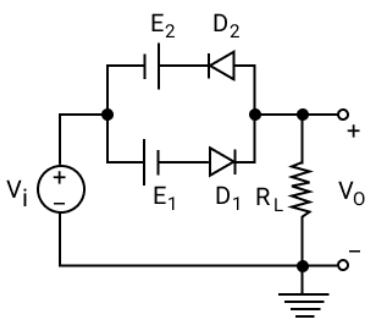
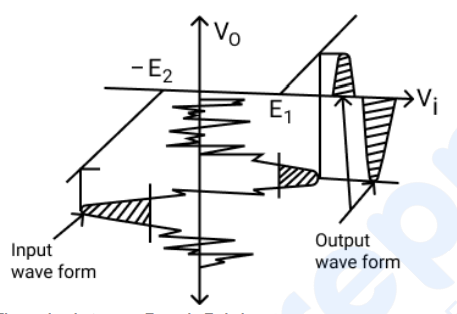
dead zone
The given circuit has a specific behavior where the output is zero when the input voltage ranges between +E1 and -E2. This region has distinct characteristics in the context of its input-output relationship.
To analyze the behavior of the circuit, consider the following principles:
- Concept of Zones: In electronic circuits, particularly in signal processing and control systems, specific regions of the input-output characteristics are identified as zones. These may include active, cutoff, saturation, or dead zones.
- Definition of Dead Zone: The dead zone refers to the input range where the output remains constant, typically at zero. This means within this range, any variation in the input voltage does not affect the output.
- Behavior Analysis: Given that the output is zero when the input lies between +E1 and -E2, it clearly indicates a lack of response to changes in this input range. Such behavior is typical of a dead zone.
Therefore, in this circuit, the region between +E1 and -E2 is known as the dead zone.
Important Questions from Logic Gates and Boolean Algebra
The digital circuit shown has 3 inputs ($x$, $y$, and $z$).
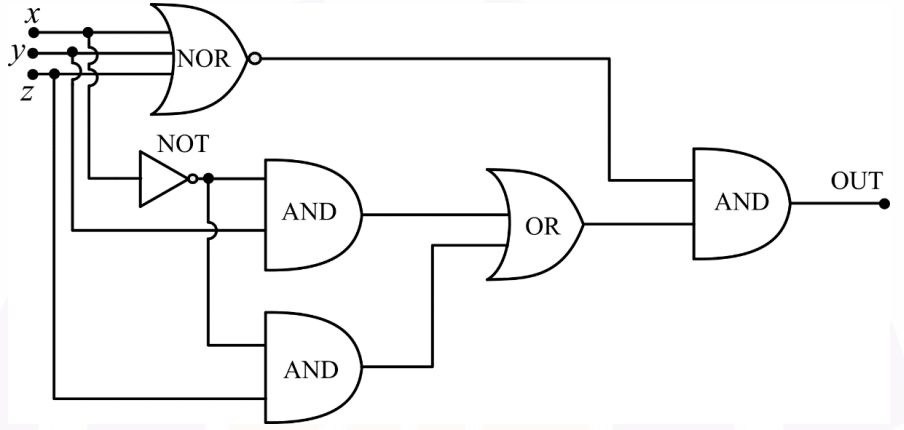
The simplified logical expression for the output (OUT) is:
The MOSFET switches shown in the circuit are ideal.
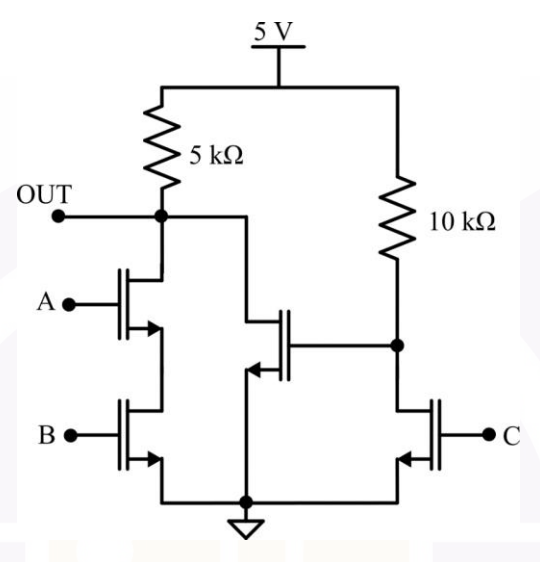
Which of the following is the correct option for Boolean logical expression of the output (OUT), and the maximum possible power (P) consumed by the circuit?
The Boolean expression \(AC+B\bar{C}\) is equivalent to :
Consider the following expressions :
(a) Y = f(A, B, C, D) = Σ (1, 2, 4, 7, 8, 11, 13, 14)
(b) Y = f(A, B, C, D) = Σ (3, 5, 7, 10, 11, 12, 13, 14)
(c) Y = f(A, B, C, D) = Π (0, 3, 5, 6, 9, 10, 12, 15)
(d) Y = f(A, B, C, D) = Π (0, 1, 2, 4, 5, 8, 9, 15)Which of the above expressions are equivalent to the expression Y = A⊕B⊕C⊕D ?
- Match the Exclusive-OR (XOR) operations (i) to (iv) with the results (p) to (s), where X is a Boolean input.
(i) $X \oplus X$ (p) 1 (ii) $X \oplus \bar{X}$ (q) 0 (iii) $X \oplus 0$ (r) $\bar{X}$ (iv) $X \oplus 1$ (s) X


