
A*B*A, where * represents XOR, is equal to:
B
Understanding XOR Operations: Simplifying A * B * A
The question asks us to simplify the expression A * B * A, where the asterisk (*) represents the XOR operation. The XOR (Exclusive OR) operation is a fundamental concept in digital logic and Boolean algebra. It is a binary operation that outputs true (1) only when inputs differ (one is true, the other is false) and outputs false (0) when inputs are the same (both true or both false).
The symbol commonly used for XOR is $\oplus$. So, the expression can be written as A $\oplus$ B $\oplus$ A.
Key Properties of the XOR Operation
To simplify this expression, we need to use the properties of the XOR operation. The most relevant properties for this problem are:
- Commutative Property: The order of operands does not affect the result. A $\oplus$ B is the same as B $\oplus$ A.
- Associative Property: The grouping of operands does not affect the result in a sequence of XOR operations. (A $\oplus$ B) $\oplus$ C is the same as A $\oplus$ (B $\oplus$ C). This allows us to rearrange the terms.
- Inverse Property: XORing any value with itself results in the identity element, which is 0 (or False). A $\oplus$ A = 0.
- Identity Property: XORing any value with 0 (False) results in the original value. A $\oplus$ 0 = A.
Step-by-Step Simplification of A $\oplus$ B $\oplus$ A
Let's simplify the expression A $\oplus$ B $\oplus$ A using these properties:
- Start with the given expression: A $\oplus$ B $\oplus$ A
- Use the Associative Property to group terms. We can group A $\oplus$ A together: (A $\oplus$ A) $\oplus$ B
- Apply the Inverse Property to the grouped term A $\oplus$ A. We know that A $\oplus$ A = 0. So, the expression becomes: 0 $\oplus$ B
- Finally, apply the Identity Property to 0 $\oplus$ B. We know that 0 $\oplus$ B = B.
So, the simplified expression is B.
Let's quickly verify with an example using binary values (A=1, B=0):
A $\oplus$ B $\oplus$ A = 1 $\oplus$ 0 $\oplus$ 1
= (1 $\oplus$ 0) $\oplus$ 1 (Using Associative Property)
= 1 $\oplus$ 1 (Since 1 $\oplus$ 0 = 1)
= 0 (Since 1 $\oplus$ 1 = 0)
Wait, this example does not yield B (which is 0). Let's re-examine the steps and example.
The grouping (A $\oplus$ A) $\oplus$ B is correct due to associativity and commutativity. Let's retry the example carefully with the correct grouping:
A $\oplus$ B $\oplus$ A = (A $\oplus$ A) $\oplus$ B
Let A = 1, B = 0:
(1 $\oplus$ 1) $\oplus$ 0
= 0 $\oplus$ 0 (Since 1 $\oplus$ 1 = 0)
= 0 (Since 0 $\oplus$ 0 = 0)
In this example, B was 0, and the result is 0. So, the result B holds for this example.
Let A = 1, B = 1:
(1 $\oplus$ 1) $\oplus$ 1
= 0 $\oplus$ 1 (Since 1 $\oplus$ 1 = 0)
= 1 (Since 0 $\oplus$ 1 = 1)
In this example, B was 1, and the result is 1. So, the result B holds for this example too.
Let A = 0, B = 1:
(0 $\oplus$ 0) $\oplus$ 1
= 0 $\oplus$ 1 (Since 0 $\oplus$ 0 = 0)
= 1 (Since 0 $\oplus$ 1 = 1)
In this example, B was 1, and the result is 1. The result B holds.
Let A = 0, B = 0:
(0 $\oplus$ 0) $\oplus$ 0
= 0 $\oplus$ 0 (Since 0 $\oplus$ 0 = 0)
= 0 (Since 0 $\oplus$ 0 = 0)
In this example, B was 0, and the result is 0. The result B holds.
The step-by-step simplification using the properties of XOR is robust and confirmed by examples.
Comparing with the Options
The simplified expression is B. Let's look at the provided options:
- B
- ABA
- $\bar{A}$
- A
Our result, B, matches the first option.
Revision Table: XOR Properties Review
| Property | Description | Expression |
|---|---|---|
| Commutative | Order doesn't matter | A $\oplus$ B = B $\oplus$ A |
| Associative | Grouping doesn't matter | (A $\oplus$ B) $\oplus$ C = A $\oplus$ (B $\oplus$ C) |
| Inverse | XOR with self | A $\oplus$ A = 0 |
| Identity | XOR with 0 | A $\oplus$ 0 = A |
Additional Information: Applications of XOR
The XOR operation is widely used in various fields:
- Digital Logic Circuits: XOR gates are fundamental components in building circuits like adders, parity checkers, and multiplexers.
- Cryptography: XOR is used in encryption algorithms because of its reversibility (A $\oplus$ B = C implies A $\oplus$ C = B and B $\oplus$ C = A).
- Error Detection and Correction: Parity bits and cyclic redundancy checks (CRCs) often use XOR.
- Computer Graphics: Used in operations like drawing sprites on screens.
- Set Theory: Corresponds to the symmetric difference of two sets.
Understanding the properties of XOR is crucial for working with these applications.
Important Questions from Logic Gates and Boolean Algebra
The number of distinct Boolean expressions of four variables is-
Which of the following types is best suited to represent the logical values?
In the given circuit, if the input voltage lies between +E1 and -E2, then output is zero.
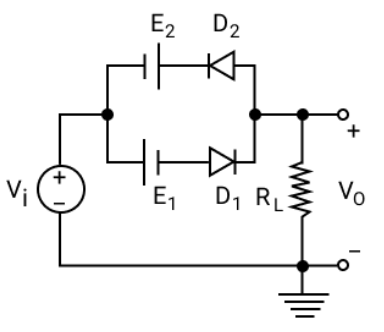
Input and output characteristics are shown below.
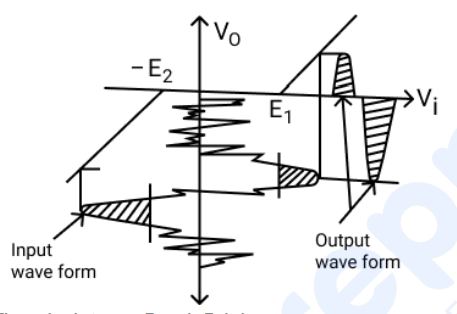
The region between +E1 and -E2 is known as _____.
The minimum number of 2-input NAND gates required to realize the logic function $Y = AB + \bar A \bar B$ is
The theorem to which the given two powerful laws in Boolean algebra belong to, is:
Law 1:\(\overline{A + B} = \overline A \ \overline B\)
Law 2:\(\overline{A B} = \overline A \ + \overline B\)


