Traverse Adjustment Rules Explained
This question requires identifying the correct statements regarding two common methods used in surveying for traverse adjustment: the Bowditch rule and the Transit rule. These rules help distribute measurement errors in a closed traverse.
Understanding Traverse Adjustment Rules
Bowditch Rule Applicability
The Bowditch rule is employed when both the angular and linear measurements taken during a traverse survey are considered to have similar levels of precision. In this scenario, the total error is distributed proportionally to the lengths of the individual traverse legs (sides).
- Statement A is Correct: This aligns with the principle that Bowditch rule is most effective when measurement precision is consistent across angles and distances.
Transit Rule Applicability
The Transit rule is used when the angular measurements are significantly more precise than the linear (distance) measurements. The error is distributed proportionally to the latitudes and departures (or Northings/Southings and Eastings/Westings) of the traverse legs.
- Statement B is Correct: This reflects the condition where higher confidence is placed in angle measurements compared to distance measurements.
Incorrect Statements Analysis
- Statement C is Incorrect: While latitudes and departures are fundamental to traverse calculations, the Bowditch rule distributes error based on the *length* of each traverse leg, not directly using the arithmetic sum of latitudes/departures for the distribution mechanism itself. The adjustment is proportional to leg length.
- Statement D is Incorrect: The Transit rule distributes error based on the *latitude and departure* values of each leg, not the traverse perimeter.
Conclusion
Based on the principles of traverse adjustment:
- Statement A is correct because Bowditch rule applies when angular and linear measurements have equal precision.
- Statement B is correct because the Transit rule is preferred when angular measurements are more precise than linear ones.
- Statements C and D incorrectly describe the adjustment mechanism or conditions for Bowditch and Transit rules, respectively.
Therefore, the correct statements are A and B.
Important Questions from Traversing
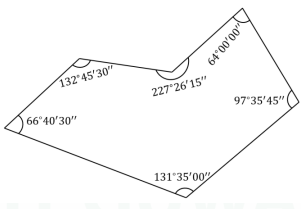
- The forebearing of four sides of a closed quadrilateral ABCDA are
AB = 60°, BC = 149.87°, CD = 269.5°, DA = 20.17°.
The calculated value of interior angle D is _____° (Answer in decimal degrees and rounded off to two decimal values). The angular misclosure of the closed-loop traverse shown in the figure is _____________ ° (Answer in decimal degrees and rounded off to three decimal places)
- It is needed to establish the coordinates of a station A. Two stations B and C are available whose coordinates are given in the table.
Length of line CA = 1212.38 m; ∠BCA = 64°.
The Easting of station A is _______ m (Rounded off to two decimal places).
Assume station A lies to the west of the traverse line BC.Station Easting (m) Northing (m) B 11054.09 9484.37 C 10827.62 10112.15 - If the departure and latitude of a line are 70 m and -130 m, respectively, then the whole circle bearing of the line in degrees is
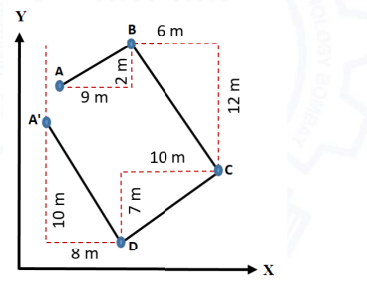
While carrying out a traverse survey ABCDA' using a theodolite with the originating station A, the departures and latitudes of the lines, as obtained, are shown in the following figure (not drawn to scale). It is seen that, due to the observational errors, the originating station A and its computed station A' are not the same. For this survey, the 'closing error' in m is