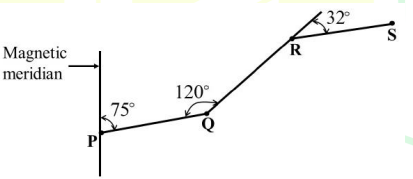
Calculating Whole Circle Bearing
The Whole Circle Bearing (WCB) represents the angle measured clockwise from the North direction to the line.
We are given the components of the line:
- Departure = 70 m (Eastward component)
- Latitude = -130 m (Southward component)
Determining the Line's Quadrant
A positive departure indicates the line moves East. A negative latitude indicates the line moves South. Therefore, the line lies in the Southeast (SE) quadrant.
Calculating the Reference Angle
First, calculate the acute angle ($\alpha$) the line makes with the North-South meridian using the absolute values of departure (D) and latitude (L).
The formula is:
Substitute the given values:
Find the angle $\alpha$:
Finding the Whole Circle Bearing (WCB)
For lines in the Southeast quadrant, the WCB is calculated relative to the North direction.
The angle from North clockwise to South is $180^\circ$. The reference angle $\alpha$ calculated is the angle Eastward from the South meridian.
The WCB formula for the SE quadrant is:
Substitute the calculated $\alpha$:
Rounding to the nearest degree, the Whole Circle Bearing is 152 degrees.
Important Questions from Traversing
- The forebearing of four sides of a closed quadrilateral ABCDA are
AB = 60°, BC = 149.87°, CD = 269.5°, DA = 20.17°.
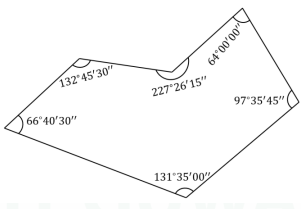
The calculated value of interior angle D is _____° (Answer in decimal degrees and rounded off to two decimal values). The angular misclosure of the closed-loop traverse shown in the figure is _____________ ° (Answer in decimal degrees and rounded off to three decimal places)
- It is needed to establish the coordinates of a station A. Two stations B and C are available whose coordinates are given in the table.
Length of line CA = 1212.38 m; ∠BCA = 64°.
The Easting of station A is _______ m (Rounded off to two decimal places).
Assume station A lies to the west of the traverse line BC.Station Easting (m) Northing (m) B 11054.09 9484.37 C 10827.62 10112.15 While carrying out a traverse survey ABCDA' using a theodolite with the originating station A, the departures and latitudes of the lines, as obtained, are shown in the following figure (not drawn to scale). It is seen that, due to the observational errors, the originating station A and its computed station A' are not the same. For this survey, the 'closing error' in m is
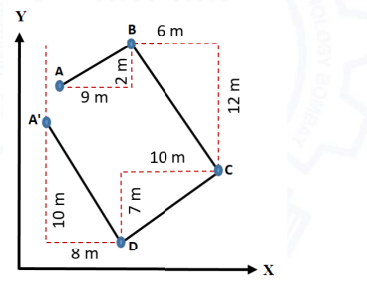
Figure below shows an open traverse PQRS, where P is the starting point of traverse and S is the end point of traverse. Which one of the following is correct?