Which of the following statements are correct? Choose the correct answer from the options given below:
A, B, C, E Only
Understanding Optical Phenomena: Light Deviation, Imaging, Diffraction, Polarization, and Coherence
Let's analyze each statement provided to determine its correctness based on the principles of optics.
Statement A: Minimum Deviation and Wavelength
The statement says that the angle at minimum deviation of a prism is greater for violet light than that for red light.
The angle of minimum deviation ($\delta_m$) for a prism is related to its refractive index ($\mu$) and the prism angle (A) by the formula:
$$\mu = \frac{\sin\left(\frac{A + \delta_m}{2}\right)}{\sin\left(\frac{A}{2}\right)}$$
For a given prism angle A, a larger refractive index $\mu$ results in a larger angle of minimum deviation $\delta_m$. The refractive index of a material generally decreases as the wavelength of light increases (this is known as dispersion). Violet light has a shorter wavelength than red light. Therefore, the refractive index of the prism material is greater for violet light ($\mu_{violet}$) than for red light ($\mu_{red}$).
Since $\mu_{violet} > \mu_{red}$, it follows that $\delta_{m, violet} > \delta_{m, red}$.
Thus, the angle at minimum deviation for violet light is indeed greater than that for red light.
Statement A is correct.
Statement B: Purpose of Microscopes and Telescopes
The statement says that the purpose of microscopes and telescopes is to increase the visual angle.
Optical instruments like microscopes and telescopes are used to view objects that are either too small (microscope) or too far away (telescope) to be seen clearly with the naked eye. They achieve this by forming an image that subtends a larger visual angle at the eye than the object itself would. The visual angle is the angle an object or its image subtends at the eye. Increasing the visual angle makes the object or image appear larger, allowing us to see details more clearly.
Statement B is correct.
Statement C: Condition for Diffraction
The statement says that for the diffraction to take place, the size of aperture or of the obstacle should be comparable to the wavelength of light.
Diffraction is the bending of waves around obstacles or through openings. This phenomenon is most significant when the size of the obstacle or aperture is of the same order of magnitude as the wavelength of the wave. If the obstacle or aperture is much larger than the wavelength, the bending effect is negligible, and light travels in straight lines (geometrical optics). If the obstacle is much smaller, the wave might pass around it with minimal disturbance, or if it's an aperture, it might act like a point source (Huygens' principle).
Therefore, the condition for noticeable diffraction is that the size of the diffracting object (aperture or obstacle) should be comparable to the wavelength of the light.
Statement C is correct.
Statement D: Polarization of Scattered Light
The statement says that the light scattered in the direction of the incident light is always plane polarized.
Scattering of light involves interaction with particles in the medium. In phenomena like Rayleigh scattering (which explains why the sky is blue), the degree of polarization of scattered light depends on the scattering angle. Light scattered at 90 degrees to the direction of incidence is typically plane polarized. However, light scattered in the forward direction (same direction as incident light) or backward direction is generally not polarized or is only partially polarized. Complete plane polarization usually occurs only for specific scattering angles relative to the incident direction and polarization state.
Therefore, scattered light in the direction of incident light is not always plane polarized.
Statement D is incorrect.
Statement E: Coherent Sources
The statement says that the source and its virtual image can behave as coherent sources.
Coherent sources are sources of waves that have the same frequency and maintain a constant phase difference over time. For light, coherence is crucial for observing sustained interference patterns. One method to create coherent sources from a single original source is to use a method that splits the wavefront or amplitude of the light from the original source and then recombines them. A source and its virtual image formed by a mirror (like in Lloyd's mirror experiment) or a lens can act as coherent sources because the waves originating from the virtual image are effectively coming from the same original wavefront, maintaining a constant phase relationship.
Statement E is correct.
Summary of Statement Correctness:
- Statement A: Correct
- Statement B: Correct
- Statement C: Correct
- Statement D: Incorrect
- Statement E: Correct
| Statement | Correctness | Reason |
|---|---|---|
| A | Correct | μviolet > μred, leading to δviolet > δred. |
| B | Correct | Instruments increase visual angle for better viewing. |
| C | Correct | Diffraction is significant when object size ≅ λ. |
| D | Incorrect | Forward scattered light is generally not plane polarized. |
| E | Correct | A source and its image can be used as coherent sources (e.g., Lloyd's mirror). |
The correct combination of statements is A, B, C, and E.
Revision Table: Key Optics Concepts
| Concept | Brief Explanation | Related Statements |
|---|---|---|
| Minimum Deviation of Prism | The smallest angle of deviation experienced by light passing through a prism; depends on refractive index and prism angle. | A |
| Visual Angle | The angle subtended by an object or its image at the eye; relates to perceived size. | B |
| Diffraction | Bending of waves around obstacles or through apertures. | C |
| Scattering and Polarization | Interaction of light with particles; scattered light can be polarized depending on scattering angle and incident polarization. | D |
| Coherent Sources | Sources emitting waves with constant phase difference, necessary for sustained interference. | E |
Additional Information on Light Phenomena
Understanding these concepts is crucial for optics. Let's elaborate slightly:
- Dispersion: The phenomenon where the refractive index of a material varies with the wavelength of light. This is why a prism separates white light into its constituent colors (VIBGYOR), with violet deviating the most and red the least because $\mu$ is highest for violet and lowest for red.
- Angular Magnification: Microscopes and telescopes provide angular magnification, which means they increase the visual angle. This is different from linear magnification, although both contribute to making objects appear larger or closer.
- Huygens' Principle: This principle states that every point on a wavefront can be considered as a source of secondary spherical wavelets, and the new wavefront is the envelope of these wavelets. Diffraction can be explained using Huygens' principle and the superposition of these wavelets.
- Polarization: Light is a transverse electromagnetic wave. Polarization refers to the direction of oscillation of the electric field vector. Unpolarized light has electric field oscillations in all directions perpendicular to the propagation direction. Polarized light has oscillations in a specific direction or pattern. Scattering, reflection, and passing through polarizing filters can cause polarization.
- Interference: The superposition of two or more waves leading to a resultant wave of greater, smaller, or the same amplitude. For sustained interference patterns to be observed, the sources must be coherent. Methods to create coherent sources from a single source include using mirrors, prisms, or beamsplitters.
These fundamental concepts explain a wide range of optical phenomena we observe daily and are the basis for many optical technologies.
Important Questions from Electric Charges and Fields
Two charged particles, placed at a distance d apart in vacuum, exert a force F on each other. Now, each of the charges is doubled. To keep the force unchanged, the distance between the charges should be changed to:
When a slab of insulating material 4 mm thick is introduced between the plates of a parallel plate capacitor of separation 4 mm, it is found that the distance between the plates has to be increased by 3.2 mm to restore the capacity to its original value. The dielectric constant of the material is:
Match List - I with List - II.
List - I List - II (A) Electric Field (I) [LTA] (B) Electric Flux (II) [L2] (C) Electric Dipole Moment (III) [ML3T−3A−1] (D) Area Vector Element (IV) [MLT−3A−1] Choose the correct answer from the options given below:
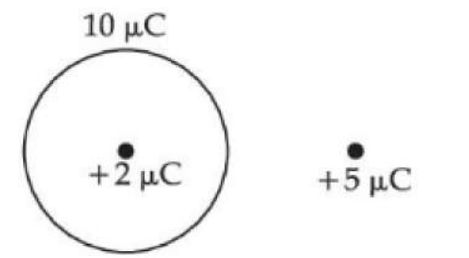
A thin metallic spherical shell contains a charge +10 μC on it. A point charge +2 μC is placed at the centre of the shell and another charge +5 μC is placed outside it as shown. The force on the charge +2 μC at the centre is:
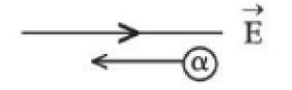
In the figure, an α-particle moves a distance l in a uniform electric field E as shown. Does the Electric Field do a positive or a negative work on the α-particle? Does the electric potential energy of the α-particle increase or decrease?