
Which of the following represents an ideal current source(es) and ideal voltage source(es) behaviour ?
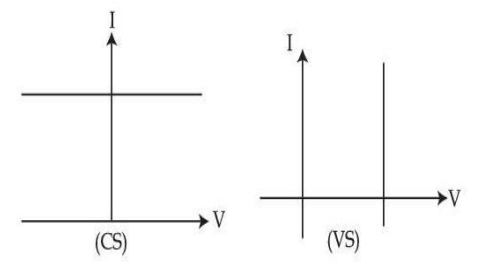
Each ideal source holds one variable fixed and lets the other take whatever value the circuit demands, so on the I-V plane each is a straight line parallel to one axis — the pair drawn in option 2.
| Source | Holds constant | Free to vary | I-V curve |
|---|---|---|---|
| Ideal current source | Current I | Voltage V | Horizontal line |
| Ideal voltage source | Voltage V | Current I | Vertical line |
Reading the plots. With I on the vertical axis and V on the horizontal:
The current source delivers the same I whatever voltage appears across it, so as V changes the operating point slides sideways at constant height — a horizontal line.
The voltage source holds V fixed whatever current is drawn, so the operating point slides up and down at fixed horizontal position — a vertical line.
What the slope means, and why the other options fail. The slope of an I-V characteristic is a conductance, so its reciprocal is the source's internal resistance:
\(R_{int}=\dfrac{dV}{dI}\)
A horizontal line has \(dI/dV=0\), so \(R_{int}\to\infty\) — correct for an ideal current source, which must be unaffected by whatever it is connected to. A vertical line has \(dV/dI=0\), so \(R_{int}=0\) — correct for an ideal voltage source. Option 1 shows sloping curves, which describe sources with finite internal resistance, that is practical rather than ideal sources. Option 3's oscillating curves describe no source at all, and option 4 assigns the two line orientations the wrong way round.
The practical picture completes the idea. A real voltage source is an ideal one with a small series resistance, giving a steep but not vertical line that droops as current is drawn; a real current source is an ideal one with a large shunt resistance, giving a nearly horizontal line that sags as voltage rises. The ideal cases are the limits \(R_{s}\to0\) and \(R_{p}\to\infty\).
Two consequences worth stating follow directly from the graphs: an ideal voltage source must never be short-circuited, since the vertical line permits unlimited current, and an ideal current source must never be open-circuited, since the horizontal line permits unlimited voltage.
Hence, the correct pair is option 2.
Important Questions from Circuit Elements - Teaching
Capacitor that can have the highest capacitance value is
The resistor which is nonlinear in nature is called as:
A 100 Ω resistor has a conductance of:
- The color code for a 47 Ω resistor with 1% tolerance would be:
The resistances in the higher range are mostly made of:



