Which of the following is NOT an advantage of LVDT?
Limited dynamic response
LVDT Introduction
The LVDT, which stands for Linear Variable Differential Transformer, is a passive inductive transducer. It is an electromechanical device that converts the rectilinear motion of an object into a corresponding electrical signal. LVDTs are widely used for precise measurement of linear displacement, position, and vibration in various industrial and scientific applications. Understanding the inherent characteristics of an LVDT, including its operational benefits (advantages) and limitations (disadvantages), is fundamental for its appropriate selection and application.
LVDT Advantages Explained
LVDTs are highly regarded in many measurement and control systems due to their distinct advantages. Let's explore the primary advantages that make an LVDT a preferred choice for displacement sensing:
- Infinite Resolution: A significant advantage of the LVDT is its virtually infinite resolution. This means that an LVDT can detect and provide an output signal for even the most minuscule changes in the core's position. The output is continuous, allowing for the measurement of infinitely small displacements, which is crucial for applications demanding extreme precision.
- Low Hysteresis: Hysteresis refers to the phenomenon where the output signal for a given input differs depending on the direction from which that input was approached. LVDTs exhibit very low hysteresis. This characteristic ensures that the output voltage for a specific core position remains nearly identical whether the core is moving towards that position or away from it, leading to highly accurate and repeatable measurements. This low hysteresis contributes significantly to the LVDT's overall measurement accuracy.
- Linearity: Another major advantage of an LVDT is its excellent linearity over its specified operating range. The output voltage of an LVDT is directly proportional to the displacement of its core. This linear relationship simplifies the calibration process and signal conditioning, as the displacement can be easily calculated from the output voltage using a straightforward linear equation. This high degree of linearity makes the LVDT a reliable sensor for accurate displacement sensing.
- Frictionless Operation: The operating principle of the LVDT involves no physical contact between the movable core and the stationary coil structure. This frictionless operation eliminates wear and tear, reducing mechanical degradation over time. This absence of friction contributes to the LVDT's long operational life and ensures consistent performance without the need for frequent maintenance or recalibration due to mechanical wear.
- Robustness and Durability: LVDTs are known for their rugged construction. Because there are no mechanical contacts, pivot points, or sliding elements to wear out, they are highly durable. They can operate reliably in harsh environmental conditions, including high temperatures, vibrations, and shocks, making them suitable for demanding industrial applications where other sensors might fail.
LVDT Disadvantage: Limited Dynamic Response
Despite its many advantages, the LVDT also has certain limitations that must be considered during sensor selection. One such limitation, which is a disadvantage, is its limited dynamic response:
- Dynamic Response Definition: The dynamic response of a sensor indicates how quickly it can accurately track rapid changes in the measured parameter. For an LVDT, its ability to respond to fast-changing displacements is not as high as some other sensor types.
- Core Mass and Inertia: The primary factor contributing to the limited dynamic response of an LVDT is the physical mass and inertia of its core. For the LVDT to accurately measure high-frequency or rapidly changing displacements, its core must be able to accelerate and decelerate quickly to follow the motion. The inertia of the core can prevent it from tracking extremely fast movements precisely.
- Coil Inductance: The inductive nature of the LVDT's coils also plays a role in its dynamic behavior. Inductive circuits naturally resist rapid changes in current, which can slightly impede the sensor's ability to instantaneously respond to very high-frequency input displacements.
- Application Implications: Consequently, LVDTs are generally not the optimal choice for applications requiring the measurement of extremely high-frequency vibrations or extremely fast-changing displacements. While they are excellent for precise linear measurements, their dynamic response is a known limitation when compared to certain other transducer technologies designed specifically for high-speed motion tracking. Therefore, limited dynamic response is a clear disadvantage, not an advantage, of an LVDT.
LVDT Characteristics Summary
To summarize the characteristics of an LVDT based on the options provided:
- Infinite resolution is a highly desirable advantage, allowing for precise measurement of minute displacements.
- Low hysteresis is a significant advantage, contributing to the LVDT's accuracy and repeatability.
- Linearity is a key advantage, simplifying data interpretation and calibration due to the proportional relationship between displacement and output.
- Limited dynamic response is a recognized disadvantage of the LVDT, as its core's inertia and coil inductance can restrict its ability to accurately measure very rapid or high-frequency displacements.
Hence, among the given choices, "Limited dynamic response" is the characteristic that is NOT an advantage of an LVDT; instead, it is a known limitation or disadvantage.
Important Questions from Resistive Transducers
Flow can be measured by ____.
- Active strain gauges are connected in a half-bridge configuration to measure strain in a cantilever element. When powered by a voltage source of 10 V, the voltage at the output of the bridge is 1 mV. If the gauge factor is 2.5, the strain in the cantilever element is ________ microstrain.
An engineer is designing a feedback control system using a potentiometer transducer to measure angular position. What is the primary effect if a voltmeter with low resistance is connected to measure the potentiometer output?
- A wire-wound ‘resistive potentiometer type' angle sensor with 72 turns is used in an application. The first turn of the potentiometer is connected to ground while its last turn is connected to 3.6 V. The width of the wiper covers two turns ensuring make-before-break. The output (wiper) voltage when the wiper is on top of both the turns 35 and 36 is ________ V (rounded off to two decimal places).
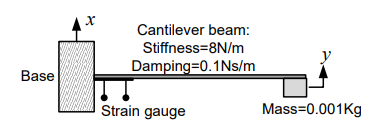
A strain gauge is attached on a cantilever beam as shown. If the base of the cantilever vibrates according to the equation \[ x(t) = \sin \omega_1 t + \sin \omega_2 t, \] where \(2~\text{rad/s} < \omega_1, \omega_2 < 3~\text{rad/s}\), then the output of the strain gauge is proportional to