
Steel Truss Components: Identifying the Outlier
This solution identifies which component listed is NOT typically considered a primary part of a steel truss structure.
Analyzing Steel Truss Components
We need to determine which of the given options does not belong to a typical steel truss system. Let's examine each component:
- Gusset Plate: These are essential metal plates used to connect the various members (chords and webs) of a steel truss at its joints (nodes). They provide the necessary structural integrity for the truss.
- Wall Plate: This component typically rests on top of a load-bearing wall. Its function is to provide a level surface and distribute the load from the supported structure, such as rafters or the base of a truss, onto the wall. It supports the truss but is not part of the truss itself.
- Fish Plate: Primarily used for splicing or joining structural members end-to-end, often seen in timber construction or railway applications. While steel members can be spliced, fish plates are not the standard connection method for the joints *within* a typical steel truss, which predominantly uses gusset plates.
- Anchor Bolts: These are used to securely fasten the base of a steel structure, including the base plate of a truss or column, to the foundation (e.g., concrete). They connect the truss assembly to the building's foundation but are external to the truss members.
Conclusion on Truss Membership
While Wall Plates and Anchor Bolts connect the truss to the building or foundation, they are external support or connection elements. Fish Plates, however, are specifically designed for joining members linearly. In the context of a steel truss, where connections are primarily nodal (using gusset plates) and the overall structure connects via base plates and anchor bolts, the fish plate is the least representative component typically found *as part of* the truss's fundamental structure and connection system.
Important Questions from Building Construction Techniques
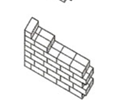
Match the brick masonry bond type in Group I with the corresponding illustration in Group II
Group I Group II (P) Rat Trap (1) 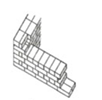
(Q) English (2) 
(R) Flemish (3) 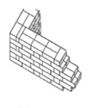
(S) Stretcher (4) 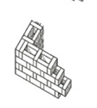
(5) 
- Cold joint' refers to the
- Match the Elements in Group - I with their Applications in Group - II
Group - I Group - II P Bracket 1 Door Q Baluster 2 Dome R Key stone 3 Cornice S Holdfast 4 Arch 5 Staircase - Match the Vibrator Types in Group-I with their related Areas of Application in Group-II
Group-I Group-II P Needle Vibrator 1 Concrete Pavement Q Shutter Vibrator 2 Pre-cast Concrete Unit R Surface Vibrator 3 Beam-Column Junction S Table Vibrator 4 Retaining Wall 5 Slip Forming - Match the type of Temporary Structures in Group - I with their corresponding Functions in Group - II
Group-I Group-II P Scaffolding 1 To support unsafe structure Q Formwork 2 To support platforms for workmen and materials at raised height during construction R Shoring 3 Removal of water from pits S Underpinning 4 Mould for RCC Structure 5 Strengthening the existing foundation


