
Which of the following is incorrect reference to the array in FORTRAN :
A (N, X)
The rule being tested. In FORTRAN an array subscript must evaluate to an integer. A subscript may be an integer constant, an integer variable, or an integer expression built from them, but it may never be a real (floating-point) quantity, because a subscript selects a discrete storage location and a fractional index has no meaning.
Step 1 — how FORTRAN decides a variable's type. Under the implicit typing rules of classical FORTRAN, a name beginning with the letters I, J, K, L, M or N is INTEGER; a name beginning with any other letter (A–H or O–Z) is REAL. This is the famous "I through N" convention, and it is exactly what the question turns on.
Step 2 — test each option.
| Reference | Subscripts | Valid? |
|---|---|---|
| A (2, 5) | two integer constants | valid |
| A (2 * 3, 6) | integer expression 2×3 = 6, and a constant | valid |
| A (N, X) | N is integer, but X begins with X, so X is REAL | invalid |
| A (LOCATION, 8) | LOCATION begins with L, so it is integer | valid |
Step 3 — read off the odd one out. Only A (N, X) uses a real subscript, so it is the incorrect array reference.
Why the other three tempt you. A (2 * 3, 6) looks suspicious because it contains an operator, but arithmetic expressions are perfectly legal subscripts as long as the result is integer — here 2×3 = 6. A (LOCATION, 8) looks suspicious because the name is long and descriptive, but the only thing that matters is its first letter, L, which makes it an integer under the implicit rule. If the array had been declared with a name starting in A–H, that would affect the type of the array's elements, not the legality of its subscripts.
Modern practice. Because implicit typing causes exactly this kind of silent bug, current FORTRAN code almost always begins with IMPLICIT NONE and declares every variable explicitly — then X would have to be declared INTEGER before it could ever be used as a subscript.
Hence, the incorrect reference is A (N, X).
Similar Questions
The function "isalnum( )" returns a non-zero value if the character is alphanumeric and zero otherwise. What is header file to be used in the main program ?
To read a integer variable, find the correct format given below :
Int m;
Find the correct list, which is the reverse (at all levels) of the given list :
[[4, 7, 8], 2, 9, [19, 6], 20, 3]
(i) 3, 20
(ii) 9, 2
(iii) [6, 19]
(iv) [8, 7, 4]Which of the following is not an infinite loop ?
(A) int i = 1;
while (1)
{
i++ ;
}
(B) for ( ; ; ) ;
(C) int t = 0, f ;while (t)
{
f = 1;
}
(D) int y, x = 0 ;
do
{
y = x;
}
while (x == 0);
The three types of loops available in C language are
i. for
ii. while
iii. do-whileWhich loops do not operate without testing the condition even once ?
Match the following :
List – I List – II a. associativity i. memory storage b. # define ii. if-then-else c. auto iii. operators with equal precedence d. conditional operator iv. define operator Codes :
Assertion (A) : 'C' uses many data types such as integers (short and long) and float etc.
Reason (R) : Conversion specifier used for short unsigned integer is % lu.
Which bitwise operator is suitable for turning off a particular bit in a number ?
Which storage class is used for the variables that are often required in a program ?
Which is not a proper way of array declaration ?
Important Questions from Miscellaneous
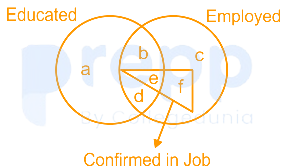
Read the given figure and find the region representing persons who are educated and employed but not confirmed in job.
The magazine in which Mahatma Gandhi mentioned what he wanted the Constitution to do is:
Which gas shields the surface of the earth from ultraviolet radiation from the sun?
Which event is marked as an Intangible Cultural Heritage of Humanity by UNESCO?
Who has been conferred with the rank of the Commander of the Order of the British Empire in 2018?



