
Which among the following is correct option for adiabatic reversible expansion of an ideal gas?
Understanding Adiabatic Reversible Expansion of an Ideal Gas
Let's analyze the characteristics of an adiabatic reversible expansion process involving an ideal gas. An adiabatic process is one where no heat is exchanged with the surroundings, meaning the heat flow, $\Delta Q$, is zero. A reversible process is an ideal process that can be reversed without leaving any change in the system or the surroundings. For an ideal gas, the internal energy depends only on temperature.
Properties of Adiabatic Reversible Expansion
Consider the key thermodynamic quantities for this process:
- Heat Exchange ($\Delta Q$): By definition of an adiabatic process, there is no heat exchange with the surroundings.
$\Delta Q = 0$
- Entropy Change for the Surroundings ($\Delta S_{surr}$): For any process, the entropy change of the surroundings is given by the heat transferred to the surroundings divided by the temperature of the surroundings.
$\Delta S_{surr} = \frac{Q_{surr}}{T_{surr}}$
In an adiabatic process, $Q_{system} = 0$. By the first law of thermodynamics, $Q_{surr} = -Q_{system} = 0$. Therefore, the entropy change for the surroundings is zero.$\Delta S_{surr} = 0$
- Total Entropy Change ($\Delta S_{total}$): The total entropy change for a process is the sum of the entropy change of the system and the entropy change of the surroundings ($\Delta S_{total} = \Delta S_{system} + \Delta S_{surr}$). For any reversible process, the total entropy change is zero. Since this process is reversible, we have:
$\Delta S_{total} = 0$
Combined with $\Delta S_{surr} = 0$, this implies that the entropy change for the system ($\Delta S_{system}$) is also zero for a reversible adiabatic process.$\Delta S_{system} = 0$
- Internal Energy Change ($\Delta U$): According to the first law of thermodynamics, the change in internal energy is given by $\Delta U = \Delta Q - \Delta W$, where $\Delta W$ is the work done by the system. For an adiabatic process, $\Delta Q = 0$, so $\Delta U = -\Delta W$. During expansion, the gas does work on the surroundings, so $\Delta W > 0$. This means $\Delta U < 0$.
- Temperature Change ($\Delta T$): For an ideal gas, the internal energy depends only on temperature, and the change in internal energy is related to the temperature change by $\Delta U = nC_v\Delta T$, where $n$ is the number of moles and $C_v$ is the molar heat capacity at constant volume. Since $\Delta U < 0$ during adiabatic expansion, $\Delta T$ must also be negative.
$\Delta T < 0$
This confirms that the temperature change is not zero.$\Delta T \ne 0$
Evaluating the Options
Based on our analysis:
- Entropy change for surroundings = 0
- Total entropy change = 0
- $\Delta T \ne 0$
Let's check the provided options against these findings. The option that states 'Entropy change for surroundings = 0, Total entropy change = 0, $\Delta T \ne 0$' matches our derived characteristics for an adiabatic reversible expansion of an ideal gas.
Important Questions from First law of thermodynamics
- An ideal gas undergoes a process where $50J$ of work is done on the gas, and $30J$ of heat is removed from the gas.
Which of the following statements is true for the gas? When a gas is compressed suddenly then its temperature
During throttling process:
2 mol of a monoatomic ideal gas with initial volume of 5 L and pressure 10 bar undergoes an irreversible adiabatic expansion against a constant final pressure of 1 bar. The final volume (in L) is ________.
(Given: R = $8.314 \times 10^{-2}$ L bar $mol^{-1}$ $K^{-1}$)
(rounded off to one decimal place)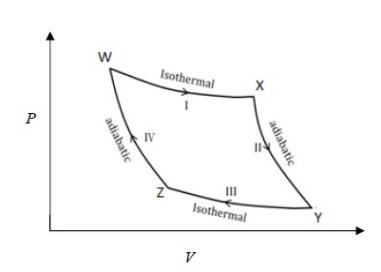
From the above Carnot cycle undergone by an ideal gas, identify the processes in which the change in internal energy is NON-ZERO.


