
Which of the following statements is true for the gas?
Understanding Ideal Gas Processes and Thermodynamics
This question involves analyzing a process for an ideal gas using the principles of thermodynamics, specifically the First Law of Thermodynamics. We are given information about the work done and heat transferred, and we need to determine the effect on the gas's state.
Applying the First Law of Thermodynamics
The First Law of Thermodynamics provides a relationship between the change in internal energy of a system ($\Delta U$), the heat added to the system ($Q$), and the work done *by* the system ($W$). The formula is:
$ \Delta U = Q - W $
Let's break down the terms and the given information:
- Change in Internal Energy ($\Delta U$): This represents the change in the total energy contained within the gas molecules. For an ideal gas, internal energy is solely dependent on temperature.
- Heat ($Q$): This is the thermal energy transferred to or from the gas. A positive $Q$ means heat is added to the gas, while a negative $Q$ means heat is removed.
- Work ($W$): This is the energy transferred when the gas expands or contracts against an external pressure. A positive $W$ means the gas does work on its surroundings (expansion), while a negative $W$ means work is done on the gas by its surroundings (compression).
Analyzing the Given Information
We need to carefully interpret the given values:
- Work done *on* the gas is $50J$. This means the surroundings did work on the gas, causing compression. In the context of the First Law formula ($\Delta U = Q - W$), work done *on* the gas is negative. Therefore, $W = -50J$.
- Heat is removed *from* the gas ($30J$). This means the gas lost thermal energy. In the context of the First Law formula, heat removed is negative. Therefore, $Q = -30J$.
Summary of Given Values
| Quantity | Symbol | Value | Meaning |
|---|---|---|---|
| Work done on the gas | $W_{on}$ | $50J$ | Implies $W = -50J$ in the formula |
| Heat removed from the gas | $Q_{removed}$ | $30J$ | Implies $Q = -30J$ in the formula |
Calculating the Change in Internal Energy
Now, we can substitute the values of $Q$ and $W$ into the First Law equation:
$ \Delta U = Q - W $
$ \Delta U = (-30J) - (-50J) $
$ \Delta U = -30J + 50J $
$ \Delta U = +20J $
The calculation shows that the change in internal energy ($\Delta U$) is positive ($+20J$).
Relating Internal Energy to Temperature
For an ideal gas, the internal energy ($U$) is directly proportional to its absolute temperature ($T$). This means if the internal energy increases, the temperature increases, and if the internal energy decreases, the temperature decreases.
Since we found that $\Delta U = +20J$ (an increase in internal energy), the temperature of the ideal gas must also increase.
Evaluating the Options
Let's examine each statement based on our findings:
- 1. The temperature will increase.: As shown above, the positive change in internal energy ($\Delta U = +20J$) directly implies an increase in temperature for an ideal gas. This statement is true.
- 2. The internal energy will decrease.: Our calculation yielded $\Delta U = +20J$, indicating an increase, not a decrease. This statement is false.
- 3. The volume will increase.: Work was done *on* the gas ($W = -50J$), which typically signifies compression (a decrease in volume). While the internal energy increased, this doesn't guarantee an overall volume increase. This statement is likely false.
- 4. The pressure will decrease.: The change in pressure depends on the combined effects of changes in volume and temperature. While temperature increased, the volume likely decreased due to work being done *on* the gas. The net effect on pressure is unclear without more information about the specific process. This statement is not necessarily true and is likely false.
Conclusion
Based on the First Law of Thermodynamics and the properties of ideal gases, the increase in internal energy directly leads to an increase in temperature. Therefore, the statement "The temperature will increase" is the correct conclusion.
Important Questions from First law of thermodynamics
During throttling process:
- The maximum work (|$W_{max}$|, in kJ) that can be obtained by complete combustion of 1.0 mol of $CH_4$ at constant pressure and 25 $^\circ$C is ______ (rounded off to one decimal place).
(Given: $\Delta S = -241.60$ J K$^{-1}$ mol$^{-1}$; $\Delta H = -890.01$ kJ mol$^{-1}$; $R = 8.314$ J mol$^{-1}$ K$^{-1}$) When a gas is compressed suddenly then its temperature
2 mol of a monoatomic ideal gas with initial volume of 5 L and pressure 10 bar undergoes an irreversible adiabatic expansion against a constant final pressure of 1 bar. The final volume (in L) is ________.
(Given: R = $8.314 \times 10^{-2}$ L bar $mol^{-1}$ $K^{-1}$)
(rounded off to one decimal place)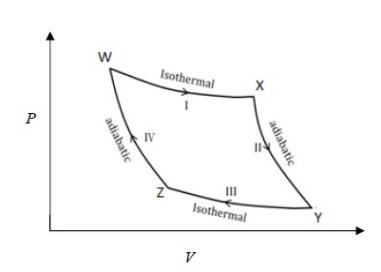
From the above Carnot cycle undergone by an ideal gas, identify the processes in which the change in internal energy is NON-ZERO.


