
When a gas is compressed suddenly then its temperature
Rises
Understanding Sudden Gas Compression and Temperature
When a gas is compressed suddenly, it means that the compression happens very quickly. This rapid process does not allow sufficient time for heat to be exchanged between the gas and its surroundings. A thermodynamic process in which no heat transfer occurs between the system (the gas) and its surroundings is called an adiabatic process.
Applying the First Law of Thermodynamics
The First Law of Thermodynamics states that the change in internal energy of a system (\(\Delta U\)) is equal to the heat added to the system (\(\Delta Q\)) minus the work done by the system (\(\Delta W\)). Mathematically, this is expressed as:
\[ \Delta U = \Delta Q - \Delta W \]
In the case of a sudden compression, the process is adiabatic, which means the heat exchange (\(\Delta Q\)) is zero:
\[ \Delta Q = 0 \]
Substituting this into the First Law of Thermodynamics gives:
\[ \Delta U = 0 - \Delta W \]
\[ \Delta U = - \Delta W \]
Work Done During Compression
When a gas is compressed, work is done *on* the gas by the external force or pressure. The work done *by* the gas (\(\Delta W\)) is defined as the work done by the system on its surroundings. During compression, the volume of the gas decreases, and the gas is doing negative work on the surroundings (or the surroundings are doing positive work on the gas). Therefore, \(\Delta W\) is negative.
Let's represent the negative work done by the gas as \(\Delta W = -|\Delta W|\), where \(|\Delta W|\) is a positive value representing the magnitude of the work done on the gas.
Change in Internal Energy
Using the modified First Law equation for an adiabatic process:
\[ \Delta U = - \Delta W \]
Substitute the negative value for \(\Delta W\):
\[ \Delta U = - (-|\Delta W|) \]
\[ \Delta U = |\Delta W| \]
Since \(|\Delta W|\) is positive, the change in internal energy (\(\Delta U\)) is positive. This means the internal energy of the gas increases during sudden compression.
Internal Energy and Temperature
For an ideal gas, the internal energy depends only on its temperature. Specifically, the change in internal energy is directly proportional to the change in temperature (\(\Delta T\)):
\[ \Delta U \propto \Delta T \]
Since we found that the internal energy of the gas increases (\(\Delta U \gt 0\)) during sudden compression, it follows that the temperature of the gas must also increase (\(\Delta T \gt 0\)).
Conclusion
Therefore, when a gas is compressed suddenly, its temperature rises because the work done on the gas adiabatically increases its internal energy.
- Sudden compression is an adiabatic process (\(\Delta Q = 0\)).
- Work is done on the gas (\(\Delta W\) is negative).
- According to the First Law of Thermodynamics (\(\Delta U = -\Delta W\)), the internal energy increases.
- Increased internal energy of a gas means increased temperature.
Important Questions from First law of thermodynamics
During throttling process:
- The maximum work (|$W_{max}$|, in kJ) that can be obtained by complete combustion of 1.0 mol of $CH_4$ at constant pressure and 25 $^\circ$C is ______ (rounded off to one decimal place).
(Given: $\Delta S = -241.60$ J K$^{-1}$ mol$^{-1}$; $\Delta H = -890.01$ kJ mol$^{-1}$; $R = 8.314$ J mol$^{-1}$ K$^{-1}$) 2 mol of a monoatomic ideal gas with initial volume of 5 L and pressure 10 bar undergoes an irreversible adiabatic expansion against a constant final pressure of 1 bar. The final volume (in L) is ________.
(Given: R = $8.314 \times 10^{-2}$ L bar $mol^{-1}$ $K^{-1}$)
(rounded off to one decimal place)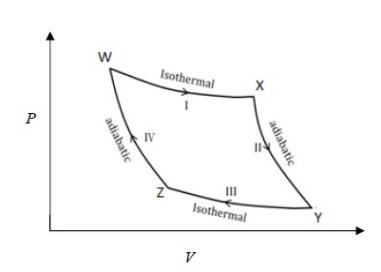
From the above Carnot cycle undergone by an ideal gas, identify the processes in which the change in internal energy is NON-ZERO.
- The internal energy of an ideal gas follows the equation $U = 3.5 PV+k$, where k is a constant. The gas expands from an initial volume of $0.25 m^3$ to a final volume of $0.86 m^3$. If the initial pressure is $5 N m^{-2}$, the change in internal energy (in Joules) is (given $PV^{1.3}$ = constant) ________


