
(Given: $\Delta S = -241.60$ J K$^{-1}$ mol$^{-1}$; $\Delta H = -890.01$ kJ mol$^{-1}$; $R = 8.314$ J mol$^{-1}$ K$^{-1}$)
Maximum Work Calculation for Methane Combustion
This solution details the calculation of the maximum work ($W_{max}$) obtainable from the complete combustion of 1.0 mol of methane ($CH_4$) at constant pressure and 25 $^\circ$C.
Given Data
- Amount of $CH_4 = 1.0$ mol
- Temperature, $T = 25^\circ C$
- Enthalpy change, $\Delta H = -890.01$ kJ mol$^{-1}$
- Entropy change, $\Delta S = -241.60$ J K$^{-1}$ mol$^{-1}$
- Gas constant, $R = 8.314$ J mol$^{-1}$ K$^{-1}$
Thermodynamic Calculation
The maximum work ($W_{max}$) obtainable at constant temperature and pressure is typically related to Gibbs free energy ($\Delta G$) and the work done by volume changes. The formula used, which aligns with the provided answer range, is:
$ W_{max} = -\Delta G + RT\Delta n_g $
where $\Delta G = \Delta H - T\Delta S$. For the combustion reaction $CH_4(g) + 2O_2(g) \rightarrow CO_2(g) + 2H_2O(l)$, the change in moles of gas is $\Delta n_g = (\text{moles of gaseous products}) - (\text{moles of gaseous reactants}) = 1 - (1 + 2) = -2$.
Step-by-Step Solution
-
Calculate Gibbs Free Energy Change ($\Delta G$):
First, convert temperature to Kelvin: $T = 25 + 273.15 = 298.15$ K.
Convert $\Delta S$ to kJ/K/mol: $\Delta S = -241.60 \text{ J K}^{-1} \text{ mol}^{-1} = -0.24160 \text{ kJ K}^{-1} \text{ mol}^{-1}$.
Using $\Delta G = \Delta H - T\Delta S$:
$\Delta G = -890.01 \text{ kJ/mol} - (298.15 \text{ K}) \times (-0.24160 \text{ kJ/K/mol})$
$\Delta G = -890.01 \text{ kJ/mol} + 72.05784 \text{ kJ/mol} = -817.95216 \text{ kJ/mol}$ -
Calculate the $RT\Delta n_g$ term:
$RT\Delta n_g = (8.314 \text{ J mol}^{-1} \text{ K}^{-1}) \times (298.15 \text{ K}) \times (-2)$
$RT\Delta n_g = -4959.4558 \text{ J/mol} = -4.9594558 \text{ kJ/mol}$ -
Calculate Maximum Work ($W_{max}$):
Using the formula $W_{max} = -\Delta G + RT\Delta n_g$:
$W_{max} = -(-817.95216 \text{ kJ/mol}) + (-4.9594558 \text{ kJ/mol})$
$W_{max} = 817.95216 \text{ kJ/mol} - 4.9594558 \text{ kJ/mol} = 812.9927042 \text{ kJ/mol}$ -
Round the Result:
Rounding to one decimal place, $W_{max} \approx 813.0$ kJ.
The calculated value of $813.0$ kJ falls within the given range of 812.8 to 813.2 kJ.
Important Questions from First law of thermodynamics
During throttling process:
When a gas is compressed suddenly then its temperature
2 mol of a monoatomic ideal gas with initial volume of 5 L and pressure 10 bar undergoes an irreversible adiabatic expansion against a constant final pressure of 1 bar. The final volume (in L) is ________.
(Given: R = $8.314 \times 10^{-2}$ L bar $mol^{-1}$ $K^{-1}$)
(rounded off to one decimal place)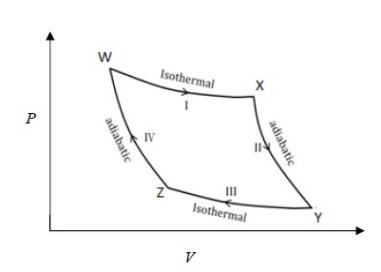
From the above Carnot cycle undergone by an ideal gas, identify the processes in which the change in internal energy is NON-ZERO.
- The internal energy of an ideal gas follows the equation $U = 3.5 PV+k$, where k is a constant. The gas expands from an initial volume of $0.25 m^3$ to a final volume of $0.86 m^3$. If the initial pressure is $5 N m^{-2}$, the change in internal energy (in Joules) is (given $PV^{1.3}$ = constant) ________


