
During throttling process:
enthalpy does not change
Understanding the Throttling Process
The throttling process is a thermodynamic process that involves the expansion of a fluid (gas or liquid) through a restriction, such as a valve, porous plug, or capillary tube. This process is typically rapid and occurs without significant heat transfer to or from the surroundings (adiabatic) and without any significant change in kinetic or potential energy. Also, there is no work done by or on the fluid during the throttling process.
Thermodynamic Analysis of Throttling
We can analyze the throttling process using the steady-flow energy equation. For a steady-flow process, the energy equation is given by:
$\dot{Q} - \dot{W} = \dot{m} \left[ \left( h_2 - h_1 \right) + \frac{V_2^2 - V_1^2}{2} + g \left( z_2 - z_1 \right) \right]$
Where:
- $\dot{Q}$ is the rate of heat transfer
- $\dot{W}$ is the rate of work done
- $\dot{m}$ is the mass flow rate
- $h$ is enthalpy
- $V$ is velocity
- $z$ is elevation
- Subscripts 1 and 2 refer to the inlet and outlet conditions, respectively.
For a throttling process:
- It is usually assumed to be adiabatic, so $\dot{Q} = 0$.
- There is no work done, so $\dot{W} = 0$.
- Changes in kinetic energy ($\frac{V_2^2 - V_1^2}{2}$) are often negligible, especially if the restriction is small compared to the overall flow area, or if the velocity changes are not significant.
- Changes in potential energy ($g \left( z_2 - z_1 \right)$) are also usually negligible as the elevation change is typically small.
Substituting these assumptions into the steady-flow energy equation:
$0 - 0 = \dot{m} \left[ \left( h_2 - h_1 \right) + 0 + 0 \right]$
$0 = \dot{m} (h_2 - h_1)$
Since the mass flow rate $\dot{m}$ is not zero for flow to occur, we must have:
$h_2 - h_1 = 0$
Which means:
$h_2 = h_1$
Thus, the enthalpy of the fluid remains constant during an ideal throttling process. This is why throttling is also known as an isenthalpic process.
Analyzing the Options
Let's examine the given options in the context of the throttling process:
- Pressure does not change: This is incorrect. Throttling involves expansion through a restriction, which causes a significant drop in pressure from inlet to outlet ($P_2 < P_1$).
- Internal energy does not change: This is incorrect. For an ideal gas, internal energy depends only on temperature ($u = u(T)$). While enthalpy is constant ($h = u + Pv$), pressure decreases. If temperature changes (which it can, depending on the fluid and initial conditions - e.g., for ideal gas, temperature is constant, but for real gases and liquids, it typically changes), then internal energy also changes. Even if temperature is constant (ideal gas throttling), pressure changes significantly, so $u$ changes if $P$ changes and $v$ changes such that $Pv$ is constant. For real fluids, temperature and internal energy generally change.
- Entropy does not change: This is incorrect. The throttling process is highly irreversible due to the rapid expansion through the restriction. For an adiabatic irreversible process, entropy always increases ($s_2 > s_1$).
- Enthalpy does not change: This is correct, as derived from the steady-flow energy equation under standard assumptions for throttling. The process is characterized by constant enthalpy.
Therefore, the property that does not change during a throttling process is enthalpy.
Important Questions from First law of thermodynamics
- The maximum work (|$W_{max}$|, in kJ) that can be obtained by complete combustion of 1.0 mol of $CH_4$ at constant pressure and 25 $^\circ$C is ______ (rounded off to one decimal place).
(Given: $\Delta S = -241.60$ J K$^{-1}$ mol$^{-1}$; $\Delta H = -890.01$ kJ mol$^{-1}$; $R = 8.314$ J mol$^{-1}$ K$^{-1}$) When a gas is compressed suddenly then its temperature
2 mol of a monoatomic ideal gas with initial volume of 5 L and pressure 10 bar undergoes an irreversible adiabatic expansion against a constant final pressure of 1 bar. The final volume (in L) is ________.
(Given: R = $8.314 \times 10^{-2}$ L bar $mol^{-1}$ $K^{-1}$)
(rounded off to one decimal place)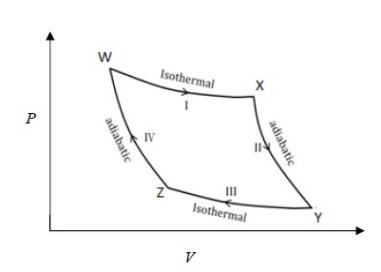
From the above Carnot cycle undergone by an ideal gas, identify the processes in which the change in internal energy is NON-ZERO.
- The internal energy of an ideal gas follows the equation $U = 3.5 PV+k$, where k is a constant. The gas expands from an initial volume of $0.25 m^3$ to a final volume of $0.86 m^3$. If the initial pressure is $5 N m^{-2}$, the change in internal energy (in Joules) is (given $PV^{1.3}$ = constant) ________


