
From the above Carnot cycle undergone by an ideal gas, identify the processes in which the change in internal energy is NON-ZERO. 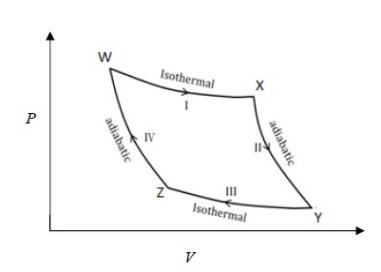
The Carnot cycle consists of four processes: two isothermal and two adiabatic. Let's analyze each process in the cycle to determine where the internal energy change is non-zero.
- Process I (W to X): Isothermal Expansion
- In an isothermal process, the temperature remains constant.
- For an ideal gas, the change in internal energy (\(\Delta U\)) is zero because internal energy depends only on temperature.
- Process II (X to Y): Adiabatic Expansion
- In an adiabatic process, no heat is exchanged (\(Q = 0\)).
- The work done results in a change in internal energy.
- Thus, the change in internal energy (\(\Delta U \neq 0\)).
- Process III (Y to Z): Isothermal Compression
- Again, the temperature remains constant.
- The change in internal energy (\(\Delta U = 0\)).
- Process IV (Z to W): Adiabatic Compression
- No heat is exchanged.
- The work done results in a change in internal energy.
- Thus, the change in internal energy (\(\Delta U \neq 0\)).
Therefore, the processes in which the change in internal energy is non-zero are II and IV, corresponding to the adiabatic processes.
Important Questions from First law of thermodynamics
During throttling process:
- The maximum work (|$W_{max}$|, in kJ) that can be obtained by complete combustion of 1.0 mol of $CH_4$ at constant pressure and 25 $^\circ$C is ______ (rounded off to one decimal place).
(Given: $\Delta S = -241.60$ J K$^{-1}$ mol$^{-1}$; $\Delta H = -890.01$ kJ mol$^{-1}$; $R = 8.314$ J mol$^{-1}$ K$^{-1}$) When a gas is compressed suddenly then its temperature
2 mol of a monoatomic ideal gas with initial volume of 5 L and pressure 10 bar undergoes an irreversible adiabatic expansion against a constant final pressure of 1 bar. The final volume (in L) is ________.
(Given: R = $8.314 \times 10^{-2}$ L bar $mol^{-1}$ $K^{-1}$)
(rounded off to one decimal place)- The internal energy of an ideal gas follows the equation $U = 3.5 PV+k$, where k is a constant. The gas expands from an initial volume of $0.25 m^3$ to a final volume of $0.86 m^3$. If the initial pressure is $5 N m^{-2}$, the change in internal energy (in Joules) is (given $PV^{1.3}$ = constant) ________


