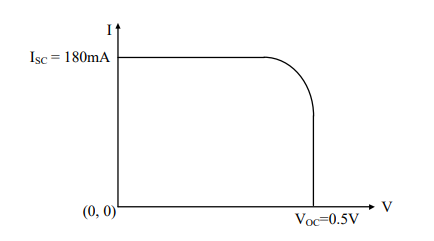
Which among the following Electronic component works with the principle of Light to Voltage conversion?
Understanding Light to Voltage Conversion in Electronics
The question asks to identify an electronic component that operates based on the principle of converting light energy directly into electrical voltage. This specific phenomenon is known as the photovoltaic effect.
Let's examine each of the given options to determine which component aligns with this principle:
- Bridge rectifier: A bridge rectifier is a circuit configuration using four or more diodes to convert alternating current (AC) into direct current (DC). Its operation is based on the properties of diodes to allow current flow in only one direction, not on light conversion.
- Zener diode: A Zener diode is a special type of diode designed to reliably allow current to flow in the reverse direction when a certain voltage, known as the Zener voltage, is reached. It is primarily used for voltage regulation or as a voltage reference. Its operation is based on avalanche breakdown or Zener breakdown, not light conversion.
- Half-wave rectifier: A half-wave rectifier is a circuit using one diode to convert only one half of the AC input cycle into pulsating DC. Like the bridge rectifier, its function is AC to DC conversion, not light to voltage conversion.
- Solar cells: Solar cells, also known as photovoltaic cells, are semiconductor devices that convert light energy into electrical energy through the photovoltaic effect. When light strikes the solar cell, it creates electron-hole pairs, which are separated by the built-in electric field of the semiconductor junction, generating a voltage and current. This directly matches the principle of light to voltage conversion.
Based on the analysis, the electronic component that works with the principle of light to voltage conversion is the solar cell.
| Electronic Component | Primary Function/Principle | Light to Voltage Conversion? |
|---|---|---|
| Bridge rectifier | AC to DC conversion | No |
| Zener diode | Voltage regulation (breakdown) | No |
| Half-wave rectifier | AC to pulsating DC conversion | No |
| Solar cells | Light energy to electrical energy (Photovoltaic effect) | Yes |
Revision Table: Electronic Component Principles
| Component Type | Key Principle | Example Application |
|---|---|---|
| Rectifier (Bridge, Half-wave) | Converting AC to DC | Power supplies |
| Zener Diode | Voltage breakdown/regulation | Voltage references, regulators |
| Solar Cell | Photovoltaic Effect (Light to Electricity) | Solar panels, light sensors |
Additional Information: The Photovoltaic Effect and Solar Cells
The working principle behind solar cells is the photovoltaic effect. This effect occurs in semiconductor materials, most commonly silicon.
- When photons (particles of light) strike a semiconductor material, they can excite electrons, freeing them from their atoms.
- In a solar cell, a junction (typically a p-n junction) is created within the semiconductor. This junction has a built-in electric field.
- This electric field separates the excited electrons and the remaining "holes" (the absence of an electron), causing them to move in opposite directions.
- The separated charge carriers accumulate on opposite sides of the junction, creating a potential difference, which is a voltage.
- When an external circuit is connected, this voltage drives a current, providing electrical power derived from light energy.
Solar cells are fundamental components in solar panels used for generating clean electricity from sunlight. They demonstrate a direct conversion of light energy into electrical energy, specifically generating a voltage and current when exposed to light.
Similar Questions
What is the main advantage of using solar energy over fossil fuels?
Which term describes the maximum amount of solar energy that a photovoltaic (PV) system can convert into electricity under standard test conditions?
Important Questions from Solar Cell
- The device that convert optical radiation into electrical energy is :
Solar cells are made of
A pn junction solar cell of area 1.0 cm2, illuminated uniformly with 100 mW cm-2, has the following parameters: Efficiency = 15%, open circuit voltage = 0.7 V, fill factor = 0.8, and thickness = 200 μm. The charge of an electron is 1.6 × 10⁻¹⁹ C. The average optical generation rate (in cm-3s-1) is
- The photocurrent of a PN junction diode solar cell is 1 mA. The voltage corresponding to its maximum power point is 0.3 V. If the thermal voltage is 30 mV, the reverse saturation current of the diode (in nA, rounded off to two decimal places) is ________.
The figure shows the I-V characteristics of a solar cell illuminated uniformly with solar light of power $100 \text{ mW/cm}^2$. The solar cell has an area of $3 \text{ cm}^2$ and a fill factor of $0.7$. The maximum efficiency (in %) of the device is ___________