A pn junction solar cell of area 1.0 cm2, illuminated uniformly with 100 mW cm-2, has the following parameters: Efficiency = 15%, open circuit voltage = 0.7 V, fill factor = 0.8, and thickness = 200 μm. The charge of an electron is 1.6 × 10⁻¹⁹ C. The average optical generation rate (in cm-3s-1) is
0.84 × 10¹⁹
Understanding the performance of a pn junction solar cell involves several key parameters, one of which is the average optical generation rate. This rate indicates how many electron-hole pairs are generated per unit volume per second due to the absorption of light. Let's break down the calculation step-by-step.
Solar Cell Parameters Overview
We are provided with the following specifications for the pn junction solar cell:
- Area (A): $\text{1.0 cm}^2$
- Illumination Intensity ($P_{in}$): $\text{100 mW cm}^{-2}$ which is equivalent to $\text{0.1 W cm}^{-2}$
- Efficiency ($\eta$): $\text{15\%}$ or $\text{0.15}$
- Open Circuit Voltage ($V_{oc}$): $\text{0.7 V}$
- Fill Factor (FF): $\text{0.8}$
- Thickness (t): $\text{200 \mu m}$ which converts to $\text{200 \times 10}^{-4} \text{ cm}$ or $\text{2 \times 10}^{-2} \text{ cm}$
- Charge of an Electron (q): $\text{1.6 \times 10}^{-19} \text{ C}$
Our objective is to determine the average optical generation rate in units of $\text{cm}^{-3}\text{s}^{-1}$.
Input Power for Solar Cell Calculation
First, we need to calculate the total input power incident on the solar cell's surface. This is found by multiplying the illumination intensity by the area of the solar cell.
The formula for total input power is:
$\text{P}_{input\_total} = \text{Illumination Intensity} \times \text{Area}$
Substituting the given values into the formula:
$\text{P}_{input\_total} = \text{100 mW cm}^{-2} \times \text{1.0 cm}^{2}$
$\text{P}_{input\_total} = \text{100 mW}$
Converting milliwatts (mW) to watts (W):
$\text{P}_{input\_total} = \text{0.1 W}$
Output Power of the Solar Cell
The efficiency of the solar cell indicates how much of the absorbed input power is converted into usable electrical output power. We can calculate this output power using the efficiency and the total input power.
The formula for output power is:
$\text{P}_{output} = \text{Efficiency} \times \text{P}_{input\_total}$
Plugging in the known values:
$\text{P}_{output} = \text{0.15} \times \text{0.1 W}$
$\text{P}_{output} = \text{0.015 W}$
Short-Circuit Current ($I_{sc}$) Derivation
The maximum electrical power ($P_{max}$) a solar cell can deliver is related to its open circuit voltage ($V_{oc}$), short-circuit current ($I_{sc}$), and fill factor (FF). The output power we calculated ($\text{P}_{output}$) is effectively this maximum power. The relationship is expressed as:
$\text{P}_{max} = \text{FF} \times \text{V}_{oc} \times \text{I}_{sc}$
Since $\text{P}_{output} = \text{P}_{max}$, we can rearrange the formula to solve for the short-circuit current ($I_{sc}$):
$\text{I}_{sc} = \frac{\text{P}_{output}}{\text{FF} \times \text{V}_{oc}}$
Substituting the calculated output power and the given parameters:
$\text{I}_{sc} = \frac{\text{0.015 W}}{\text{0.8} \times \text{0.7 V}}$
$\text{I}_{sc} = \frac{\text{0.015}}{\text{0.56}} \text{ A}$
$\text{I}_{sc} \approx \text{0.0267857 A}$
Solar Cell Volume Determination
To determine the average optical generation rate per unit volume, we must calculate the active volume of the solar cell. This is simply the product of its area and thickness.
The formula for the volume ($V_{cell}$) is:
$\text{V}_{cell} = \text{Area} \times \text{Thickness}$
It's important to ensure consistent units. The area is given in $\text{cm}^2$, and the thickness is in micrometers ($\mu \text{m}$), so we convert thickness to centimeters:
$\text{Thickness (t)} = \text{200 \mu m} = \text{200 \times 10}^{-4} \text{ cm} = \text{2 \times 10}^{-2} \text{ cm}$
Now, calculate the volume:
$\text{V}_{cell} = \text{1.0 cm}^{2} \times \text{2 \times 10}^{-2} \text{ cm}$
$\text{V}_{cell} = \text{2 \times 10}^{-2} \text{ cm}^{3}$
Average Optical Generation Rate ($G_{opt}$) Formula
The short-circuit current ($I_{sc}$) is directly proportional to the total number of electron-hole pairs generated by light and collected by the pn junction. Each collected electron-hole pair contributes one electron charge (q) to the current. Therefore, the short-circuit current can be expressed as:
$\text{I}_{sc} = \text{q} \times \text{G}_{opt} \times \text{V}_{cell}$
Where $\text{G}_{opt}$ is the average optical generation rate, and $\text{V}_{cell}$ is the volume within which generation occurs. We can rearrange this formula to solve for $\text{G}_{opt}$:
$\text{G}_{opt} = \frac{\text{I}_{sc}}{\text{q} \times \text{V}_{cell}}$
Substitute the calculated $I_{sc}$, the given electron charge (q), and the calculated cell volume ($V_{cell}$):
$\text{G}_{opt} = \frac{\text{0.0267857 A}}{(\text{1.6 \times 10}^{-19} \text{ C}) \times (\text{2 \times 10}^{-2} \text{ cm}^{3})}$
First, calculate the denominator:
$\text{Denominator} = \text{1.6 \times 10}^{-19} \times \text{2 \times 10}^{-2} = \text{3.2 \times 10}^{-21} \text{ C cm}^{3}$
Now, perform the division:
$\text{G}_{opt} = \frac{\text{0.0267857}}{\text{3.2 \times 10}^{-21}} \text{ cm}^{-3}\text{s}^{-1}$
$\text{G}_{opt} \approx \text{8370531250000000000 cm}^{-3}\text{s}^{-1}$
Expressing this in scientific notation:
$\text{G}_{opt} \approx \text{8.37} \times \text{10}^{18} \text{ cm}^{-3}\text{s}^{-1}$
To match the format of the options, which are presented as $\text{X.XX \times 10}^{19}$, we convert our result:
$\text{G}_{opt} \approx \text{0.837} \times \text{10}^{19} \text{ cm}^{-3}\text{s}^{-1}$
Final Optical Generation Rate Result
After performing all calculations, the average optical generation rate is approximately $\text{0.837 \times 10}^{19} \text{ cm}^{-3}\text{s}^{-1}$. Rounding this value to two decimal places, we get $\text{0.84 \times 10}^{19} \text{ cm}^{-3}\text{s}^{-1}$.
Important Questions from Solar Cell
- The device that convert optical radiation into electrical energy is :
Which among the following Electronic component works with the principle of Light to Voltage conversion?
Solar cells are made of
- The photocurrent of a PN junction diode solar cell is 1 mA. The voltage corresponding to its maximum power point is 0.3 V. If the thermal voltage is 30 mV, the reverse saturation current of the diode (in nA, rounded off to two decimal places) is ________.
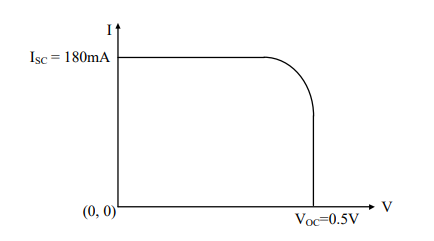
The figure shows the I-V characteristics of a solar cell illuminated uniformly with solar light of power $100 \text{ mW/cm}^2$. The solar cell has an area of $3 \text{ cm}^2$ and a fill factor of $0.7$. The maximum efficiency (in %) of the device is ___________