Solar cells are made of
Silica
Understanding What Solar Cells Are Made Of
Solar cells, also known as photovoltaic cells, are devices that convert light energy directly into electrical energy through the photovoltaic effect. These cells are the fundamental building blocks of solar panels, which are widely used for generating renewable energy.
Key Material in Solar Cells
The material used to make solar cells is crucial for their efficiency and performance. Semiconductor materials are typically used because they have properties that allow them to conduct electricity under certain conditions, like when exposed to light. The most common material used in the vast majority of solar cells is silicon.
- Silicon: Silicon is a semiconductor material abundantly available on Earth. It is extracted from silica, which is silicon dioxide (\(\text{SiO}_2\)), a major component of sand and quartz. The silicon used in solar cells is highly purified and processed into crystalline structures.
While pure silicon is the material that performs the photovoltaic conversion, the raw material from which it is derived is silica. Therefore, in the context of the given options, Silica is the most appropriate answer as it is the source material for the silicon used in solar cells.
Evaluating the Options
Let's look at the provided options:
- Silica: This is the raw material source for silicon, which is the primary semiconductor used in solar cells.
- Steel: Steel is an alloy of iron and carbon, primarily used as a structural material. It is not used for the semiconductor part of a solar cell.
- Sulphur: Sulphur is a non-metal and while some compounds involving sulphur are used in certain types of thin-film solar cells (like Cadmium Telluride CdTe or Copper Indium Gallium Selenide CIGS), it is not the main material and the fundamental building block used in most solar cells, which are silicon-based.
- Antimony: Antimony is a metalloid that can be used as a doping agent in semiconductors to modify their electrical properties, but it is not the primary material that forms the core of the solar cell.
Considering that silicon is the core material and it comes from silica, Silica is the best fit among the given choices, representing the source material for silicon solar cells.
Important Questions from Solar Cell
- The device that convert optical radiation into electrical energy is :
Which among the following Electronic component works with the principle of Light to Voltage conversion?
A pn junction solar cell of area 1.0 cm2, illuminated uniformly with 100 mW cm-2, has the following parameters: Efficiency = 15%, open circuit voltage = 0.7 V, fill factor = 0.8, and thickness = 200 μm. The charge of an electron is 1.6 × 10⁻¹⁹ C. The average optical generation rate (in cm-3s-1) is
- The photocurrent of a PN junction diode solar cell is 1 mA. The voltage corresponding to its maximum power point is 0.3 V. If the thermal voltage is 30 mV, the reverse saturation current of the diode (in nA, rounded off to two decimal places) is ________.
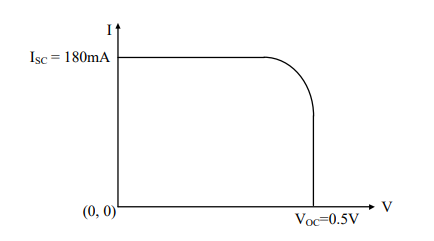
The figure shows the I-V characteristics of a solar cell illuminated uniformly with solar light of power $100 \text{ mW/cm}^2$. The solar cell has an area of $3 \text{ cm}^2$ and a fill factor of $0.7$. The maximum efficiency (in %) of the device is ___________