
Work Done by String in Circular Motion
This question asks about the work done by the string on a stone when it's whirled in a circle. To understand this, let's break down the concept of work and the physics involved in circular motion.
Understanding Work Done
In physics, work (\(W\)) is done when a force causes a displacement. Mathematically, work is calculated as the dot product of the force vector (\(\vec{F}\)) and the displacement vector (\(\vec{d}\)):
\(W = \vec{F} \cdot \vec{d} = Fd\cos\theta\)
Where:
- \(F\) is the magnitude of the force.
- \(d\) is the magnitude of the displacement.
- \(\theta\) is the angle between the force vector and the displacement vector.
Importantly, work is only done if the force has a component along the direction of displacement. If the force is perpendicular to the displacement (\(\theta = 90^\circ\)), the value of \(\cos(90^\circ) = 0\), and thus, no work is done.
Analyzing the Scenario
Consider a stone tied to a string and being whirled in a horizontal circle:
- Force: The string exerts a tension force on the stone. This tension force acts as the centripetal force, constantly pulling the stone towards the center of the circle.
- Displacement: As the stone moves along the circular path, its displacement at any given instant is tangential to the circle at that point. Imagine the stone is at the top of the circle; its instantaneous displacement is horizontally to the side.
- Angle: The tension force (centripetal force) is directed radially inward (towards the center). The instantaneous displacement is tangential to the circle. Therefore, the angle (\(\theta\)) between the force (tension) and the displacement is always \(90^\circ\).
Calculating Work Done
Using the work formula \(W = Fd\cos\theta\):
Since the angle \(\theta\) between the tension force exerted by the string and the instantaneous displacement of the stone is \(90^\circ\), we have:
\(W = (\text{Tension}) \times (\text{Displacement}) \times \cos(90^\circ)\)
\(W = F \times d \times 0\)
\(W = 0\)
Conclusion
Because the force applied by the string (tension) is always perpendicular to the direction of the stone's movement (displacement) at every point on the circular path, the work done by the string on the stone is zero. The kinetic energy of the stone remains constant (assuming the speed doesn't change), but no energy is transferred *by the string* in the form of work.
Therefore, the correct option is that the work done is zero.
Similar Questions
A 100 W electric bulb is used for 10 hours a day. How many units of energy are consumed in 30 days?
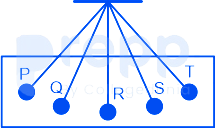
The following diagram shows a pendulum at different positions. Which one of the following statement is true?
Which one of the following does not convert electrical energy into light energy?
If an object of mass 10 kg is moving with a uniform speed of 10 m/s, then the linear momentum and the kinetic energy of the object, respectively, are
- A 100 W electric bulb is used for 10 hours a day. How many units of electrical energy are consumed by the bulb in 3 days? (1 unit = 1 kWh)
Important Questions from Work Power Energy
Which of the following is NOT correct regarding friction?
If a pump can raise 200 liters of water through a height of 300 meters in one minute, how much work can it do in one hour?
Which of the following is an example of kinetic energy?
How much kinetic energy does a 160 g cricket ball have when it is thrown at a speed of 22 m/s?
The movement of birds is an example of _______.



