
What is the value of the ratio between maximum shear stress to average shear stress for a circular section?
4/3
Calculating Shear Stress Ratio for Circular Sections
Let's understand the shear stress distribution in a circular cross-section when subjected to a shear force. Shear stress is not uniformly distributed across the section. It is maximum at the neutral axis and zero at the top and bottom edges.
Understanding Average and Maximum Shear Stress
Average Shear Stress ($\tau_{avg}$):
The average shear stress is simply the total shear force ($V$) acting on the cross-section divided by the area ($A$) of the cross-section. For any shape, including a circular section, the formula is:
For a circular section with diameter $d$, the area is $A = \frac{\pi d^2}{4}$. So, the average shear stress is:
Maximum Shear Stress ($\tau_{max}$):
The maximum shear stress in a circular section occurs at the neutral axis. This value can be derived from the general shear stress formula $\tau = \frac{VQ}{Ib}$, where $Q$ is the first moment of area, $I$ is the moment of inertia, and $b$ is the width at the point where stress is calculated. For a solid circular section, the maximum shear stress is found to be:
Substituting the area $A = \frac{\pi d^2}{4}$, we get:
Calculating the Ratio
We need to find the ratio of maximum shear stress to average shear stress, which is $\frac{\tau_{max}}{\tau_{avg}}$.
Using the formulas in terms of $V$ and $A$:
We can cancel out the $V/A$ term from both the numerator and the denominator:
Alternatively, using the formulas in terms of $V$ and $d$:
Cancel out $V$ from numerator and denominator:
Now, multiply the numerator by the reciprocal of the denominator:
Cancel out $\pi d^2$ and simplify the numbers:
Both methods yield the same result. The ratio of maximum shear stress to average shear stress for a circular section is $4/3$.
Summary of Shear Stress Ratios for Different Shapes
It is helpful to remember the shear stress ratios for common cross-sections:
| Cross-section Shape | Ratio ($\tau_{max} / \tau_{avg}$) |
|---|---|
| Rectangular | 3/2 (or 1.5) |
| Circular | 4/3 (or 1.33) |
| Triangular (base at bottom) | 3/2 (or 1.5) |
| I-section (approximate for web) | Depends on dimensions, typically > 1.5 |
For a circular section, the maximum shear stress is $4/3$ times the average shear stress.
Important Questions from Shear Stress and Bending Stress
For pure bending of a beam; which one of the following equation is valid for its analysis?
Where M: bending moment; I: moment of inertia; E: modulus of elasticity; f: bending stress at a distance y: from neutral axis; R: curvature; Z: section modulus
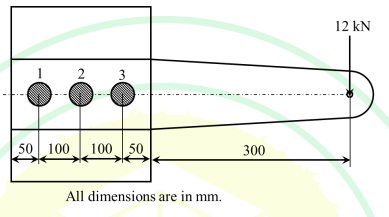
A steel plate is fastened to a channel using three identical bolts as shown in the figure. The bolts are made of carbon steel of permissible yield strength in shear as $400 \text{ N/mm}^2$. The plate is subjected to a force of 12 kN. Neglect the weight of the plate. The magnitude of the resultant shear force (in N) on bolt 2 is __________. (Answer in integer)
Based upon governing equation for the theory of pure bending which of the following is valid
A beam is said to be pure bending, when
- The relationship between the radius of curvature 'R' bending moment 'M' and flexural rigidity El is given by -


