
A steel plate is fastened to a channel using three identical bolts as shown in the figure. The bolts are made of carbon steel of permissible yield strength in shear as $400 \text{ N/mm}^2$. The plate is subjected to a force of 12 kN. Neglect the weight of the plate. The magnitude of the resultant shear force (in N) on bolt 2 is __________. (Answer in integer)
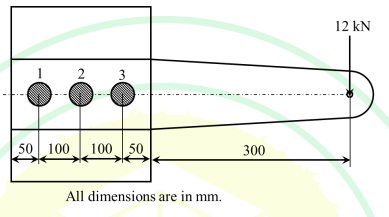
To find the magnitude of the resultant shear force on bolt 2, we must consider the two types of shear forces acting on the bolts: the primary (direct) shear force and the secondary (torsional) shear force.
1. Identify the Bolt Group Center of Gravity (CG)
The three identical bolts are arranged in a straight horizontal line. Let's define Bolt 2 as the origin (0,0).
- Bolt 1 is at $x = -100$ mm.
- Bolt 2 is at $x = 0$ mm.
- Bolt 3 is at $x = 100$ mm.
Since the bolts are identical and symmetrically spaced, the center of gravity (CG) of the bolt group is exactly at the center of Bolt 2.
2. Calculate the Primary (Direct) Shear Force
The applied vertical force $P = 12$ kN is distributed equally among the three identical bolts.
$F' = \frac{P}{n} = \frac{12000 \text{ N}}{3} = 4000 \text{ N}$
This force acts vertically downwards on all three bolts.
3. Calculate the Secondary (Torsional) Shear Force
The applied force creates a moment about the CG of the bolt group. The eccentricity ($e$) is the horizontal distance from the CG (Bolt 2) to the line of action of the force.
From the figure:
- Distance from Bolt 2 to the right edge of the channel overlap = $100 \text{ mm (to Bolt 3)} + 50 \text{ mm} = 150 \text{ mm}$.
- Distance from that edge to the force = $300 \text{ mm}$.
- Total eccentricity $e = 150 + 300 = 450 \text{ mm}$.
Moment $M = P \times e = 12000 \text{ N} \times 450 \text{ mm} = 5,400,000 \text{ N}\cdot\text{mm}$.
The formula for secondary shear force on bolt $i$ is $F''_i = \frac{M \cdot r_i}{\sum r^2}$, where $r_i$ is the distance from the CG to the bolt.
For Bolt 2, the distance from the CG is $r_2 = 0$.
Therefore, $F''_2 = 0 \text{ N}$.
4. Calculate the Resultant Shear Force on Bolt 2
The resultant force $R$ is the vector sum of the primary and secondary shear forces. Since the secondary shear force on Bolt 2 is zero, the resultant force is simply equal to the primary shear force.
$R_2 = \sqrt{(F'_2)^2 + (F''_2)^2}$
$R_2 = \sqrt{4000^2 + 0^2} = 4000 \text{ N}$
Final Answer:
The magnitude of the resultant shear force on bolt 2 is 4000 N.
Important Questions from Shear Stress and Bending Stress
For pure bending of a beam; which one of the following equation is valid for its analysis?
Where M: bending moment; I: moment of inertia; E: modulus of elasticity; f: bending stress at a distance y: from neutral axis; R: curvature; Z: section modulus
Based upon governing equation for the theory of pure bending which of the following is valid
What is the value of the ratio between maximum shear stress to average shear stress for a circular section?
A beam is said to be pure bending, when
- The relationship between the radius of curvature 'R' bending moment 'M' and flexural rigidity El is given by -


