
For pure bending of a beam; which one of the following equation is valid for its analysis? Where M: bending moment; I: moment of inertia; E: modulus of elasticity; f: bending stress at a distance y: from neutral axis; R: curvature; Z: section modulus
Beam Bending Equation for Pure Bending Analysis
In structural mechanics, understanding the behavior of beams under various loading conditions is crucial. One fundamental concept is pure bending, which occurs when a beam is subjected to a constant bending moment along its length, with no shear force present. This ideal condition helps simplify the analysis of stress and deformation within the beam.
The relationship between the internal bending moment, material properties, geometric properties, and resulting stresses and deformation in a beam undergoing pure bending is described by a fundamental equation. This equation is often referred to as the flexural formula or bending equation.
Bending Equation: The Flexural Formula
For a beam subjected to pure bending, the following equation establishes the relationship between bending moment (M), moment of inertia (I), modulus of elasticity (E), radius of curvature (R), bending stress (f), and distance from the neutral axis (y):
\(\frac{{\rm{M}}}{{\rm{I}}} = \frac{{\rm{E}}}{{\rm{R}}} = \frac{{\rm{f}}}{{\rm{y}}}\)
Let's break down each term and relationship within this important equation.
Key Terms and Their Significance
- Bending Moment (M): This is the internal resisting moment developed in the beam's cross-section due to external loads, which causes the beam to bend. It is typically measured in Newton-meters (Nm) or Pound-feet (lb-ft).
- Moment of Inertia (I): This is a geometric property of the beam's cross-section that indicates its resistance to bending. A larger moment of inertia means the beam is more resistant to bending deformation. It is measured in meters to the fourth power (\(m^4\)) or inches to the fourth power (\(in^4\)).
- Modulus of Elasticity (E): Also known as Young's Modulus, this is a material property that describes the stiffness of the material. It represents the ratio of stress to strain in the elastic region. It is measured in Pascals (Pa) or Pounds per square inch (psi).
- Radius of Curvature (R): When a beam bends, its longitudinal axis forms an arc. The radius of curvature is the radius of this arc. A larger radius of curvature indicates less bending. It is measured in meters (m) or inches (in).
- Bending Stress (f): This is the normal stress (tensile or compressive) developed within the beam's cross-section due to the bending moment. The stress varies linearly from the neutral axis. It is measured in Pascals (Pa) or Pounds per square inch (psi).
- Distance from Neutral Axis (y): This is the perpendicular distance from the neutral axis of the beam's cross-section to the point where the bending stress 'f' is being calculated. The neutral axis is an imaginary line within the beam's cross-section where the bending stress is zero.
- Section Modulus (Z): While not directly in the standard form of the pure bending equation given in the correct option, the section modulus (Z) is an important related concept. It is defined as \(Z = \frac{I}{y_{max}}\), where \(y_{max}\) is the maximum distance from the neutral axis to the outermost fiber. The maximum bending stress (\(f_{max}\)) can then be expressed as \(f_{max} = \frac{M}{Z}\).
Relationships in Pure Bending
The pure bending equation effectively combines three key relationships:
- Stress and Strain Relationship (\(\frac{{\rm{f}}}{{\rm{y}}} = \frac{{\rm{E}}}{{\rm{R}}}\)): The first part of the equation relates the bending stress (f) at a distance (y) from the neutral axis to the material's modulus of elasticity (E) and the radius of curvature (R). This comes from the assumption that plane sections remain plane and perpendicular to the neutral axis after bending, leading to a linear strain distribution. The strain (\(\epsilon\)) at a distance y is \(\epsilon = \frac{y}{R}\). Since \(f = E \cdot \epsilon\) (Hooke's Law), substituting for \(\epsilon\) gives \(f = E \frac{y}{R}\), which can be rearranged to \(\frac{{\rm{f}}}{{\rm{y}}} = \frac{{\rm{E}}}{{\rm{R}}}\).
- Moment and Stress Relationship (\(\frac{{\rm{M}}}{{\rm{I}}} = \frac{{\rm{f}}}{{\rm{y}}}\)): The second part connects the internal bending moment (M) to the bending stress (f), the moment of inertia (I), and the distance (y). This relationship is derived by considering the equilibrium of forces and moments acting on the cross-section. The internal resisting moment is the integral of the stress multiplied by the area element and its distance from the neutral axis. This leads to the formula \(M = \frac{f \cdot I}{y}\), which rearranges to \(\frac{{\rm{M}}}{{\rm{I}}} = \frac{{\rm{f}}}{{\rm{y}}}\).
- Moment-Curvature Relationship (\(\frac{{\rm{M}}}{{\rm{I}}} = \frac{{\rm{E}}}{{\rm{R}}}\)): By combining the above two relationships, we get the moment-curvature relationship, which states that the bending moment (M) is proportional to the curvature (\(\frac{1}{R}\)) and the product of the material's modulus of elasticity (E) and the cross-sectional moment of inertia (I). This product, EI, is known as the flexural rigidity of the beam, representing its overall resistance to bending.
Analyzing the Options
Let's examine the provided options in light of the standard pure bending equation:
| Option | Equation | Validity | Reasoning |
|---|---|---|---|
| 1 | \(\frac{{\rm{M}}}{{\rm{I}}} = \frac{{\rm{E}}}{{\rm{R}}} = \frac{{\rm{f}}}{{\rm{y}}}\) | Valid | This is the standard and correct equation for pure bending, establishing the relationships between bending moment, material properties, geometric properties, and stress distribution. |
| 2 | \(\frac{{\rm{M}}}{{\rm{Z}}} = \frac{{\rm{E}}}{{\rm{R}}} = \frac{{\rm{f}}}{{\rm{y}}}\) | Invalid | While \(\frac{{\rm{M}}}{{\rm{Z}}} = {\rm{f_{max}}}\) is valid (where \({\rm{f_{max}}}\) is the maximum bending stress and Z is the section modulus), the general term \(\frac{{\rm{M}}}{{\rm{Z}}}\) does not equate to \(\frac{{\rm{E}}}{{\rm{R}}}\) or \(\frac{{\rm{f}}}{{\rm{y}}}\) in this generalized form. It mixes section modulus (Z) incorrectly with the full bending equation. |
| 3 | \(\frac{{\rm{M}}}{{{\rm{EI}}}} = \frac{{\rm{I}}}{{\rm{R}}} = \frac{{\rm{f}}}{{\rm{y}}}\) | Invalid | The term \(\frac{{\rm{M}}}{{{\rm{EI}}}}\) is actually equal to \(\frac{1}{{\rm{R}}}\) (curvature), not \(\frac{{\rm{I}}}{{\rm{R}}}\). Also, \(\frac{{\rm{I}}}{{\rm{R}}}\) is not equal to \(\frac{{\rm{f}}}{{\rm{y}}}\). This option contains several incorrect relationships. |
| 4 | \(\frac{{\rm{M}}}{{\rm{Z}}} = \frac{{\rm{Z}}}{{\rm{y}}} = \frac{{\rm{f}}}{{{\rm{yI}}}}\) | Invalid | This option presents several incorrect and dimensionally inconsistent relationships. For example, \(\frac{{\rm{Z}}}{{\rm{y}}}\) is not a standard term in bending analysis in this context, and \(\frac{{\rm{f}}}{{{\rm{yI}}}}\) is also incorrect. |
Conclusion: The Correct Bending Equation
Based on the principles of mechanics of materials and the derivation for pure bending, the only accurate representation of the relationships between the bending moment (M), moment of inertia (I), modulus of elasticity (E), radius of curvature (R), bending stress (f), and distance from the neutral axis (y) is given by:
\(\frac{{\rm{M}}}{{\rm{I}}} = \frac{{\rm{E}}}{{\rm{R}}} = \frac{{\rm{f}}}{{\rm{y}}}\)
This equation is fundamental for analyzing the stresses and deformations in beams under bending loads and is widely used in engineering design.
Important Questions from Shear Stress and Bending Stress
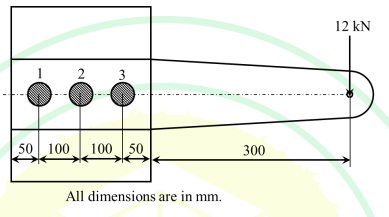
A steel plate is fastened to a channel using three identical bolts as shown in the figure. The bolts are made of carbon steel of permissible yield strength in shear as $400 \text{ N/mm}^2$. The plate is subjected to a force of 12 kN. Neglect the weight of the plate. The magnitude of the resultant shear force (in N) on bolt 2 is __________. (Answer in integer)
Based upon governing equation for the theory of pure bending which of the following is valid
What is the value of the ratio between maximum shear stress to average shear stress for a circular section?
A beam is said to be pure bending, when
- The relationship between the radius of curvature 'R' bending moment 'M' and flexural rigidity El is given by -


