
A beam is said to be pure bending, when
Shear force is zero
When a beam is subjected to bending, internal forces and stresses develop within its cross-section. These internal forces typically include both bending moments and shear forces. However, a special case exists known as 'pure bending'.
Pure Bending Condition
Pure bending occurs in a segment of a beam when that segment is subjected to a constant bending moment and zero shear force. This ideal condition simplifies the stress distribution analysis within the beam.
Let's consider the relationship between shear force and bending moment. For a simply supported beam with point loads, or a cantilever beam with specific loading, there might be sections where the shear force is zero. In such sections, the bending moment is constant.
The relationship between shear force ($V$) and bending moment ($M$) along the length of a beam ($x$) is given by:
$\frac{dM}{dx} = V$
For pure bending, the bending moment $M$ is constant with respect to $x$. If $M$ is constant, then its derivative with respect to $x$ is zero:
$\frac{dM}{dx} = 0$
This implies that the shear force $V$ must be zero:
$V = 0$
Thus, the condition for a beam segment to be in pure bending is that the shear force in that segment is zero.
Analyzing the Options
- Option 1: Bending stress is zero - In pure bending, bending stresses are maximum at the outer fibers and zero at the neutral axis. The presence of bending moment, which is characteristic of bending, implies the presence of bending stresses. So, bending stress cannot be zero throughout the section in pure bending, except at the neutral axis. This option is incorrect.
- Option 2: Shear force is zero - As explained above, a constant bending moment leads to zero shear force ($\frac{dM}{dx} = 0 = V$). This is the defining condition for pure bending. This option is correct.
- Option 3: Moment force is zero - If the bending moment is zero, the beam is not experiencing bending in that section. Pure bending requires a constant, non-zero bending moment along with zero shear force. This option is incorrect.
- Option 4: Torsional force is zero - Torsional force relates to twisting of the beam about its longitudinal axis. Bending involves forces applied perpendicular to the beam's axis causing it to deflect. While many bending problems assume no torsion, zero torsional force is not the specific condition for a beam to be in pure bending; it's a condition for the absence of torsion. Pure bending is specifically about the bending moment and shear force relationship. This option is incorrect.
Therefore, a beam is said to be in pure bending when the shear force is zero in the section under consideration.
Important Questions from Shear Stress and Bending Stress
For pure bending of a beam; which one of the following equation is valid for its analysis?
Where M: bending moment; I: moment of inertia; E: modulus of elasticity; f: bending stress at a distance y: from neutral axis; R: curvature; Z: section modulus
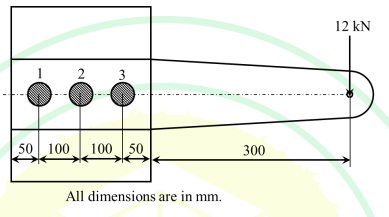
A steel plate is fastened to a channel using three identical bolts as shown in the figure. The bolts are made of carbon steel of permissible yield strength in shear as $400 \text{ N/mm}^2$. The plate is subjected to a force of 12 kN. Neglect the weight of the plate. The magnitude of the resultant shear force (in N) on bolt 2 is __________. (Answer in integer)
Based upon governing equation for the theory of pure bending which of the following is valid
What is the value of the ratio between maximum shear stress to average shear stress for a circular section?
- The relationship between the radius of curvature 'R' bending moment 'M' and flexural rigidity El is given by -


