
Based upon governing equation for the theory of pure bending which of the following is valid
Bending moment = product of bending stress and section modulus
Understanding the Governing Equation for Pure Bending
The theory of pure bending describes the behavior of a beam subjected to a constant bending moment along its length, with no shear force.
The fundamental governing equation for pure bending of a beam is given by the relationship between the bending moment, stress, strain, material properties, and the geometry of the beam cross-section. This equation is commonly expressed as:
\[ \frac{M}{I} = \frac{\sigma}{y} = \frac{E}{R} \]Let's break down what each term represents:
- \(M\) is the Bending Moment acting on the cross-section.
- \(I\) is the Moment of Inertia of the cross-section about the neutral axis.
- \(\sigma\) is the Bending Stress at a distance \(y\) from the neutral axis.
- \(y\) is the distance from the neutral axis to the point where the stress \(\sigma\) is being considered.
- \(E\) is the Modulus of Elasticity of the beam material.
- \(R\) is the Radius of Curvature of the beam.
We are interested in the relationship between the bending moment \(M\) and other properties based on this governing equation. Let's look at the first two terms of the equation:
\[ \frac{M}{I} = \frac{\sigma}{y} \]We can rearrange this equation to solve for the bending moment \(M\):
\[ M = \sigma \times \frac{I}{y} \]This equation tells us that the bending moment is related to the bending stress \(\sigma\) at a distance \(y\) from the neutral axis, and the ratio of the moment of inertia \(I\) to the distance \(y\).
The maximum bending stress (\(\sigma_{max}\)) in the beam cross-section occurs at the points furthest from the neutral axis, which are the outer fibers. Let \(y_{max}\) be the maximum distance from the neutral axis to the outer fiber.
At the outer fiber, the relationship becomes:
\[ M = \sigma_{max} \times \frac{I}{y_{max}} \]The term \(\frac{I}{y_{max}}\) is a geometric property of the beam's cross-section known as the Section Modulus, denoted by \(Z\).
\[ Z = \frac{I}{y_{max}} \]Substituting the section modulus \(Z\) into the equation for the bending moment, we get:
\[ M = \sigma_{max} \times Z \]This equation shows that the bending moment \(M\) is equal to the product of the maximum bending stress (\(\sigma_{max}\)) and the section modulus \(Z\).
Reviewing the given options:
- Option 1: Bending moment = product of modulus of elasticity and section modulus (\(M = E \times Z\)). This is not directly derived from the governing equation in this form.
- Option 2: Bending moment = product of bending stress and section modulus (\(M = \sigma \times Z\)). As derived above, \(M = \sigma_{max} \times Z\). The option uses "bending stress" which in the context of section modulus typically refers to the maximum stress \(\sigma_{max}\). This matches our derived relationship.
- Option 3: Bending moment = product of modulus of elasticity and curvature (\(M = E \times \frac{1}{R}\)). This is incorrect as the moment of inertia \(I\) is missing. The relationship is \(M = EI \times \frac{1}{R}\).
- Option 4: Bending moment = product of flexural and curvature (\(M = \text{Flexural} \times \frac{1}{R}\)). If "flexural" refers to Flexural Rigidity (\(EI\)), then \(M = EI \times \frac{1}{R}\), which is also a valid relationship from the governing equation. However, the provided correct answer points to Option 2.
Based on the standard derivation from the pure bending governing equation, the relationship \(M = \sigma_{max} Z\) is fundamental, where \(\sigma_{max}\) is the bending stress at the outer fiber and \(Z\) is the section modulus. Therefore, Option 2 accurately represents a valid relationship derived from the theory of pure bending, interpreting "bending stress" as the maximum bending stress associated with the section modulus.
Important Questions from Shear Stress and Bending Stress
For pure bending of a beam; which one of the following equation is valid for its analysis?
Where M: bending moment; I: moment of inertia; E: modulus of elasticity; f: bending stress at a distance y: from neutral axis; R: curvature; Z: section modulus
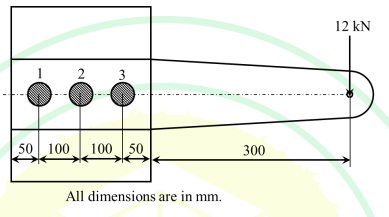
A steel plate is fastened to a channel using three identical bolts as shown in the figure. The bolts are made of carbon steel of permissible yield strength in shear as $400 \text{ N/mm}^2$. The plate is subjected to a force of 12 kN. Neglect the weight of the plate. The magnitude of the resultant shear force (in N) on bolt 2 is __________. (Answer in integer)
What is the value of the ratio between maximum shear stress to average shear stress for a circular section?
A beam is said to be pure bending, when
- The relationship between the radius of curvature 'R' bending moment 'M' and flexural rigidity El is given by -


