
____________ was a policy introduced to promote equity in Indian agriculture. The purpose was to ____________ concentration of land ownership in a few hands.
Land Ceiling; reduce.
Understanding Agricultural Policies in India
The question asks about a specific policy introduced in Indian agriculture with the primary aim of promoting equity. It further specifies that the purpose of this policy was to manage the concentration of land ownership.
Analyzing the Options
Let's look at the options provided and their general focus in the context of Indian agriculture:
- Operation Flood: This program is related to the dairy sector, aiming to increase milk production and improve the livelihoods of milk producers through cooperative structures. It is not directly related to land ownership concentration.
- Export Promotion: This refers to policies designed to boost the export of agricultural products. While important for economic growth, its primary focus is trade, not directly addressing equity through land redistribution.
- Land Ceiling: This refers to legislation that puts an upper limit on the amount of land an individual or family can own. The surplus land beyond the ceiling is then acquired by the government and often distributed among landless laborers or small farmers. This policy directly addresses the concentration of land ownership.
- Green Revolution: This was a period of significant increase in agricultural production, primarily wheat and rice, due to the introduction of high-yielding varieties of seeds, fertilizers, irrigation, and modern technology. While it impacted equity in complex ways, its core purpose was increasing production, not redistributing land ownership to reduce concentration.
Land Ceiling and Reducing Concentration of Land Ownership
Based on the analysis, the policy directly intended to promote equity by tackling the issue of unequal land distribution is the Land Ceiling policy. The very purpose of setting a ceiling on land ownership is to prevent a few individuals or entities from holding vast amounts of land while many others are landless or own very small parcels. By acquiring land above the ceiling and distributing it, the government aimed to reduce the concentration of land ownership and promote a more equitable distribution of this crucial resource.
Therefore, the blank spaces should be filled with 'Land Ceiling' and 'reduce'.
Evaluating the Complete Statement
Let's fit the correct option into the statement:
"Land Ceiling was a policy introduced to promote equity in Indian agriculture. The purpose was to reduce concentration of land ownership in a few hands."
This statement accurately describes the Land Ceiling policy's objective in India.
Comparison of Policy Focus
| Policy | Primary Focus | Impact on Land Ownership Concentration |
|---|---|---|
| Operation Flood | Dairy Production & Cooperatives | Indirect/Minimal |
| Export Promotion | Agricultural Trade | Indirect/Minimal |
| Land Ceiling | Land Redistribution & Equity | Directly aimed to Reduce |
| Green Revolution | Increasing Crop Production | Indirect (Technology Adoption) |
The table clarifies how the Land Ceiling policy stands out as the one directly addressing land ownership concentration to achieve equity.
Revision Table: Key Agricultural Policies
| Policy/Event | Period | Main Goal |
|---|---|---|
| Land Ceiling | Various stages since 1950s/60s | Reduce land ownership inequality |
| Green Revolution | Mid-1960s onwards | Increase food grain production (wheat, rice) |
| Operation Flood | Starts 1970 | Increase milk production and establish dairy cooperatives |
Additional Information: Land Reforms in India
Land Ceiling is a crucial part of broader land reforms implemented in India after independence. These reforms aimed at restructuring agrarian relations to promote agricultural productivity and ensure social justice. Key aspects of land reforms included:
- Abolition of intermediaries (like Zamindars).
- Tenancy reforms (regulating rent, providing security of tenure, conferring ownership rights).
- Ceiling on land holdings (Land Ceiling).
- Consolidation of land holdings (preventing fragmentation).
- Distribution of government wasteland and Bhoodan land.
While Land Ceiling policies faced challenges in implementation due to legal loopholes, political will, and lack of proper land records, their objective was clearly to address the highly unequal distribution of land ownership inherited from the colonial era and feudal systems, thereby promoting equity in the agricultural sector.
Similar Questions
India's health infrastructure and health care is a tier system comprising:
(i) Primary level
(ii) Secondary level
(iii) Tertiary level
Which of the following is a final source of energy?
During the period between 1950 and 1990, the proportion of GDP contributed by agriculture significantly ________.
Important Questions from Miscellaneous
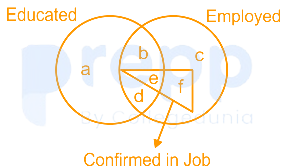
Read the given figure and find the region representing persons who are educated and employed but not confirmed in job.
The magazine in which Mahatma Gandhi mentioned what he wanted the Constitution to do is:
Which gas shields the surface of the earth from ultraviolet radiation from the sun?
Which event is marked as an Intangible Cultural Heritage of Humanity by UNESCO?
Who has been conferred with the rank of the Commander of the Order of the British Empire in 2018?



