
Two wires are made having same length and area of cross-section A. Wire 1 is made of copper and wire 2 is made of aluminium. It is given that the electrical conductivity of copper is more than that of aluminium. In this context, which one of the following statements is correct?
The resistance of wire 2 will be higher than that of wire 1.
Understanding Electrical Resistance and Conductivity
This question asks us to compare the electrical resistance of two wires made of different materials but having the same physical dimensions. Wire 1 is made of copper, and Wire 2 is made of aluminium. We are given that copper has higher electrical conductivity than aluminium.
Let's first understand the key properties involved: electrical conductivity and electrical resistance.
- Electrical Conductivity (σ): This property measures how easily electric current flows through a material. A material with high conductivity allows current to flow easily.
- Electrical Resistance (R): This property measures how much a material opposes the flow of electric current. A material with high resistance opposes current flow strongly.
Conductivity and resistivity are inversely related. Resistivity (ρ) is the inverse of conductivity (\(\rho = \frac{1}{\sigma}\)). This means that a material with higher conductivity has lower resistivity, and vice versa.
Calculating and Comparing Resistance
The resistance (R) of a wire depends on its material's resistivity (ρ), its length (L), and its cross-sectional area (A). The formula for resistance is:
\(R = \rho \frac{L}{A}\)
In this problem, both wires have the same length (L) and the same area of cross-section (A).
- For Wire 1 (Copper): Resistance \(R_1 = \rho_{Cu} \frac{L}{A}\)
- For Wire 2 (Aluminium): Resistance \(R_2 = \rho_{Al} \frac{L}{A}\)
We are given that the electrical conductivity of copper (\(\sigma_{Cu}\)) is more than that of aluminium (\(\sigma_{Al}\)):
\(\sigma_{Cu} > \sigma_{Al}\)
Since resistivity is the inverse of conductivity (\(\rho = \frac{1}{\sigma}\)), if copper has higher conductivity, it must have lower resistivity compared to aluminium:
\(\rho_{Cu} = \frac{1}{\sigma_{Cu}}\) and \(\rho_{Al} = \frac{1}{\sigma_{Al}}\)
As \(\sigma_{Cu} > \sigma_{Al}\), it follows that \(\frac{1}{\sigma_{Cu}} < \frac{1}{\sigma_{Al}}\).
Therefore, the resistivity of copper is less than the resistivity of aluminium:
\(\rho_{Cu} < \rho_{Al}\)
Now, let's compare the resistances using the formula \(R = \rho \frac{L}{A}\). Since L and A are the same for both wires, the resistance is directly proportional to the resistivity. As \(\rho_{Cu} < \rho_{Al}\), we can conclude:
\(\rho_{Cu} \frac{L}{A} < \rho_{Al} \frac{L}{A}\)
So, \(R_1 < R_2\).
This means the resistance of Wire 1 (copper) is lower than the resistance of Wire 2 (aluminium).
| Property | Copper (Wire 1) | Aluminium (Wire 2) | Comparison |
|---|---|---|---|
| Length (L) | L | L | Same |
| Area (A) | A | A | Same |
| Conductivity (σ) | Higher | Lower | σCu > σAl |
| Resistivity (ρ) | Lower | Higher | ρCu < ρAl |
| Resistance (R) | Lower | Higher | R1 < R2 |
Analyzing the Given Options
Let's examine each statement based on our finding that the resistance of Wire 1 (copper) is lower than the resistance of Wire 2 (aluminium), i.e., \(R_1 < R_2\) or \(R_2 > R_1\).
- Option 1: The resistance of wire 1 will be higher than that of wire 2.
This states \(R_1 > R_2\). This contradicts our finding \(R_1 < R_2\). So, this statement is incorrect. - Option 2: The resistance of wire 2 will be higher than that of wire 1.
This states \(R_2 > R_1\), which is equivalent to \(R_1 < R_2\). This matches our finding. So, this statement is correct. - Option 3: The resistance of both the wires will be the same.
This states \(R_1 = R_2\). This contradicts our finding \(R_1 < R_2\). So, this statement is incorrect. - Option 4: If same current is flown through both the wires, the power dissipated in both the wires will be the same.
The power dissipated (P) in a wire when a current (I) flows through it is given by \(P = I^2 R\). If the same current (I) flows through both wires, the power dissipated will be:
For Wire 1 (Copper): \(P_1 = I^2 R_1\)
For Wire 2 (Aluminium): \(P_2 = I^2 R_2\)
Since we found that \(R_1 < R_2\), it follows that \(I^2 R_1 < I^2 R_2\) (assuming I is non-zero). Therefore, \(P_1 < P_2\).
The power dissipated in Wire 1 will be less than in Wire 2. So, the power dissipated will NOT be the same. This statement is incorrect.
Based on our analysis, only the statement that the resistance of wire 2 (aluminium) will be higher than that of wire 1 (copper) is correct.
Revision Table: Electrical Properties
| Property | Description | Relationship with Resistance (R) |
|---|---|---|
| Resistivity (ρ) | Intrinsic property of material opposing current flow. | \(R \propto \rho\) (directly proportional for constant L, A) |
| Conductivity (σ) | Intrinsic property of material allowing current flow. | \(\rho = 1/\sigma\), so \(R \propto 1/\sigma\) (inversely proportional for constant L, A) |
| Length (L) | Length of the conductor. | \(R \propto L\) (directly proportional for constant ρ, A) |
| Area (A) | Cross-sectional area of the conductor. | \(R \propto 1/A\) (inversely proportional for constant ρ, L) |
Additional Information: Why Copper is Preferred
Copper is widely used for electrical wiring in homes and electronics despite aluminium being lighter and cheaper. This is primarily because copper has significantly higher electrical conductivity (and lower resistivity) than aluminium. For wires of the same length and thickness, a copper wire will have much lower resistance than an aluminium wire. Lower resistance leads to less power loss (heat generation) when current flows, which is more efficient and safer, especially for transmitting electricity over distances or handling high currents. While aluminium is used in some applications like power transmission lines (where weight is a major factor), copper remains the standard for most wiring applications due to its superior electrical properties, ductility, and corrosion resistance.
Similar Questions
Which one of the following proteins gives lustrous shiny appearance to silk fibre?
Blue Baby Syndrome is caused by the contamination of
Human insulin molecule is composed ofone α-chain having 21 amino acids andone β-chain having 30 amino acids. How many functional insulin genes occur in adult humans?
Pearl is a hard object produced within the soft tissues of a mollusk. Which one of the following is the main constituent of pearl?
A ray of light is incident on a plane mirror at an angle of 40° with respect to a surface normal. When it gets reflected from the mirror it undergoes a deviation of
Infrared, visible and ultraviolet radiations /light have different properties. Which one of the following statements related to these radiations/lights is not correct?
After using for some time, big transformers get heated up. This is due to the fact that
1. Current produces heat in transformers
2. Hysteresis loss occurs in transformers
3. Liquid used for cooling gets heated
Select the correct answer using the code given below.A person is standing on a frictionless horizontal ground. How can he move by a certain distance on this ground?
How many hydrogen atoms are contained in 1.50 g of glucose (C 6H 12 06 )?
Which of the following radioactive substances enters/enter the human body through food chain and causes/cause many physiological disorders?
Important Questions from Miscellaneous
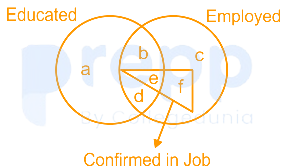
Read the given figure and find the region representing persons who are educated and employed but not confirmed in job.
The magazine in which Mahatma Gandhi mentioned what he wanted the Constitution to do is:
Which gas shields the surface of the earth from ultraviolet radiation from the sun?
Which event is marked as an Intangible Cultural Heritage of Humanity by UNESCO?
Who has been conferred with the rank of the Commander of the Order of the British Empire in 2018?



