
A person is standing on a frictionless horizontal ground. How can he move by a certain distance on this ground?
By sneezing
Understanding Motion on a Frictionless Surface
When a person is standing on a perfectly frictionless horizontal ground, the usual methods of locomotion, such as walking, running, or even simple jumping that relies on pushing against the ground horizontally or generating torque through friction, become ineffective. To move on a frictionless surface, a person needs to apply a force that results in an equal and opposite reaction force propelling them across the surface, based on Newton's Third Law of Motion.
Newton's Third Law states that for every action, there is an equal and opposite reaction. On a frictionless surface, you cannot push against the ground horizontally to generate a reaction force that moves you forward, because there is no friction to provide the grip needed for that horizontal push.
Analyzing the Options for Movement
Let's consider how each option might or might not allow movement on a frictionless horizontal surface:
- By running: Running involves pushing your feet backward against the ground. This backward push is only possible due to friction. The ground exerts an equal and opposite forward reaction force, which propels you. Without friction, you cannot push backward effectively, and you would simply slide your feet without moving forward.
- By jumping: A standard jump involves pushing downwards against the ground. On a frictionless surface, pushing purely downwards would result in an upward reaction force, lifting you off the ground but not moving you horizontally. While complex maneuvers might involve expelling something or rotating, simple jumping as typically understood won't provide horizontal motion without friction.
- By rolling: Rolling on a surface typically involves applying a torque or pushing tangentially against the surface, which relies on friction to generate linear motion. Without friction, rolling your body would likely just involve rotation without significant horizontal translation unless you expel something.
- By sneezing: Sneezing involves forcefully expelling air and possibly other particles from your body in one direction. This expulsion is an action. According to Newton's Third Law, there will be an equal and opposite reaction force pushing your body in the opposite direction of the expulsion. This reaction force acts on your body, and since the surface is frictionless, this force will cause you to accelerate and move across the ground. This is similar to how a rocket works by expelling exhaust gases.
Explanation of Sneezing and Movement on Frictionless Ground
Sneezing is an involuntary action where air is expelled at high speed. When you expel this mass (air) in one direction, your body experiences a reaction force in the opposite direction. Let's consider the physics involved:
Imagine the person and the air inside their lungs as a system. Initially, the system is at rest. When the person sneezes, they push the air out (action force). By Newton's Third Law, the expelled air exerts an equal and opposite reaction force on the person's body. Since the ground is frictionless, there is no external horizontal force opposing this reaction force, allowing the person to move.
This principle is based on the conservation of momentum in an isolated system (the person + expelled air). If the system starts with zero momentum, the momentum of the expelled air in one direction must be balanced by the momentum of the person's body in the opposite direction.
\[\text{Initial momentum} = 0\] \[\text{Final momentum} = (m_{\text{person}} \times v_{\text{person}}) + (m_{\text{air}} \times v_{\text{air}})\] \[0 = (m_{\text{person}} \times v_{\text{person}}) + (m_{\text{air}} \times v_{\text{air}})\] \[m_{\text{person}} \times v_{\text{person}} = -(m_{\text{air}} \times v_{\text{air}})\]Where \(m\) is mass and \(v\) is velocity. The negative sign indicates the velocities are in opposite directions. This equation shows that expelling mass (\(m_{\text{air}}\)) at a velocity (\(v_{\text{air}}\)) results in the person gaining velocity (\(v_{\text{person}}\)) in the opposite direction.
Conclusion
Among the given options, sneezing is the only action that involves expelling mass from the body, creating an internal force that results in an external reaction force capable of propelling the person on a frictionless surface according to Newton's Third Law of Motion.
| Method | Relies on Friction? | Generates Horizontal Force on Frictionless Ground? | Ability to Move |
|---|---|---|---|
| Running | Yes | No (requires friction for push) | Cannot Move |
| Jumping | Partially (for horizontal) | No (pure vertical push) | Cannot Move Horizontally |
| Rolling | Yes | No (requires friction for linear motion) | Cannot Move Linear (only Rotate) |
| Sneezing | No | Yes (action-reaction from expelling air) | Can Move |
Revision Table: Motion on Frictionless Surfaces
Key concepts related to movement on a frictionless surface:
- Frictionless Surface: A surface where the force of friction is negligible or zero.
- Newton's Third Law: For every action, there is an equal and opposite reaction.
- Internal Forces vs. External Forces: Internal forces within a system do not change the total momentum of the system. External forces are required to change the system's momentum.
- Momentum Conservation: In the absence of external forces, the total momentum of a system remains constant.
Additional Information on Frictionless Movement and Physics Concepts
Moving on a frictionless surface fundamentally requires an external force to change the state of motion. Since you cannot push against the frictionless ground to create this external force (like you do when walking or running), you must create an external force by expelling some mass from your own body. This is the principle behind rocket propulsion, where the rocket expels hot gas backward, propelling the rocket forward.
Other actions that could theoretically cause movement on a frictionless surface include throwing an object, spitting, or even shouting very loudly (expelling air, although the mass and velocity are usually much lower than a sneeze). The key is that some mass is expelled from the person's system in one direction, causing the rest of the person's mass to move in the opposite direction due to momentum conservation and Newton's Third Law.
Understanding action-reaction pairs is crucial here. The action is the person exerting a force on the expelled air (or object). The reaction is the expelled air (or object) exerting an equal and opposite force back on the person. This reaction force is what causes the person to move.
Similar Questions
Which one of the following proteins gives lustrous shiny appearance to silk fibre?
Blue Baby Syndrome is caused by the contamination of
Human insulin molecule is composed ofone α-chain having 21 amino acids andone β-chain having 30 amino acids. How many functional insulin genes occur in adult humans?
Pearl is a hard object produced within the soft tissues of a mollusk. Which one of the following is the main constituent of pearl?
Two wires are made having same length and area of cross-section A. Wire 1 is made of copper and wire 2 is made of aluminium. It is given that the electrical conductivity of copper is more than that of aluminium. In this context, which one of the following statements is correct?
A ray of light is incident on a plane mirror at an angle of 40° with respect to a surface normal. When it gets reflected from the mirror it undergoes a deviation of
Infrared, visible and ultraviolet radiations /light have different properties. Which one of the following statements related to these radiations/lights is not correct?
After using for some time, big transformers get heated up. This is due to the fact that
1. Current produces heat in transformers
2. Hysteresis loss occurs in transformers
3. Liquid used for cooling gets heated
Select the correct answer using the code given below.How many hydrogen atoms are contained in 1.50 g of glucose (C 6H 12 06 )?
Which of the following radioactive substances enters/enter the human body through food chain and causes/cause many physiological disorders?
Important Questions from Miscellaneous
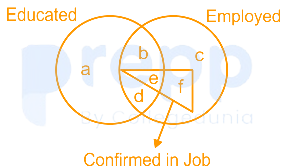
Read the given figure and find the region representing persons who are educated and employed but not confirmed in job.
The magazine in which Mahatma Gandhi mentioned what he wanted the Constitution to do is:
Which gas shields the surface of the earth from ultraviolet radiation from the sun?
Which event is marked as an Intangible Cultural Heritage of Humanity by UNESCO?
Who has been conferred with the rank of the Commander of the Order of the British Empire in 2018?



