
Two identical containers X and Y are connected at the bottom by a thin tube of negligible volume. The tube has a valve in it, as shown in the figure. Initially container X has a liquid filled up to height h in it and container Y is empty. When the valve is opened, both containers have equal amount of liquid in equilibrium. If the initial (before the valve is opened) potential energy of the liquid is P1 and the final potential energy is P2 then :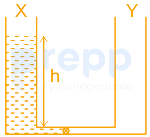
Concept:
- Potential energy is the energy possessed by a liquid by virtue of its height above the ground level.
- If m is the mass of the liquid at a height h from the ground level, the potential energy of the liquid = mgh
Calculation:
Given, when the valve is closed then the height of the liquid is h
Let the total mass of the liquid is m,
Then the initial (before the valve is opened) potential energy of the liquid is,
P1 = mgh
Now when the valve is open then the total mass remains same and equal to m, and height of the liquid h' = \(\frac 12\)h
Then the final potential energy is,
P2 = mg\(\frac 12\)h
⇒ P2 = \(\frac 12\)P1
⇒ P1 = 2P2
Similar Questions
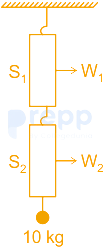
Two identical spring balances S1 and S2 are connected one after the other and are held vertically as shown in the figure. A mass of 10 kg is hanging from S2. If the readings on S1 and S2 are W1 and W2 respectively, then :
A mass is attached to a spring that hangs vertically. The extension produced in the spring is 6 cm on Earth. The acceleration due to gravity on the surface of the Moon is one-sixth of its value on the surface of the Earth. The extension of the spring on the Moon would be:
A stone is thrown horizontally from the top of a 20 m high building with a speed of 12 m/s. It hits the ground at a distance R from the building. Taking g = 10 m/s2 and neglecting air resistance will give :
Consider the following statements:
1. Distance between the longitudes becomes zero on North Pole and South Pole.
2. Distance between the longitudes is maximum on the Equator.
3. Number of longitudes is more than number of latitudes.
Which of the statements given above is/are correct?
A sphere of volume V is made of a material with lower density than water. While on Earth, it floats on water with its volume f1V (f1 < 1) submerged. On the other hand, on a spaceship accelerating with acceleration a < g (g is the acceleration due to gravity on Earth) in outer space, its submerged volume in water is f2V. Then:
A railway wagon (open at the top) of mass M1 is moving with speed v1 along a straight track. As a result of rain, after some time it gets partially filled with water so that the mass of the wagon becomes M2 and speed becomes v2. Taking the rain to be falling vertically and the water stationery inside the wagon, the relation between the two speeds v1 and v2 is :
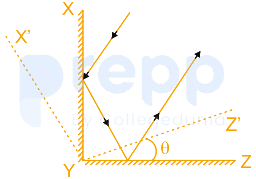
Shown in the figure are two plane mirrors XY and YZ (XY ⊥ YZ) joined at their edge. Also shown is a light ray falling on one of the mirrors and reflected back parallel to its original path as a result of this arrangement. The two mirrors are now rotated by an angle θ to their new position X'YZ', as shown. As a result the new reflected ray is at an angle α from the original reflected ray. Then :
One block of 2⋅0 kg mass is placed on top of another block of 3⋅0 kg mass. The coefficient of static friction between the two blocks is 0⋅2. The bottom block is pulled with a horizontal force F such that both the blocks move together without slipping. Taking acceleration due to gravity as 10 m/s2, the maximum value of the frictional force is :
Important Questions from Miscellaneous
The magazine in which Mahatma Gandhi mentioned what he wanted the Constitution to do is:
Which gas shields the surface of the earth from ultraviolet radiation from the sun?
Which event is marked as an Intangible Cultural Heritage of Humanity by UNESCO?
Who has been conferred with the rank of the Commander of the Order of the British Empire in 2018?
Who directead the film ‘Bhuvan Shome’?



